
Color coding can help you identify IV lines faster - but it cannot confirm that a line is correct. My takeaway: pair color with readable labels, patient and order checks, and physical line tracing.
In one simulation, wrong-fluid selections fell from 13 to 0 after a labeling change. But studies often combine color with text, placement, and training. They do not prove that color alone reduces patient harm.
Here’s what I’d focus on when reviewing a labeling plan:
- Keep meanings consistent: Use locally approved colors and label locations; there is no universal U.S. IV line color code.
- Verify every infusion: Check the medication, concentration, rate, pump channel, and intended connection - especially during handoffs and reconnections.
- Keep tubing easy to trace: Organizers such as the Beata Clasp can separate tubing, but their color is not a medication code.
- Measure safety, not just time: Track wrong-line events, administration errors, and patient harm separately from identification speed.
<u>Use color to guide attention - not to replace verification.</u>
What Research Shows About Color-Coded IV Labels
Most research points to faster, more accurate line identification in simulations. It does not prove that color-coded labels reduce patient harm.
The 2009 Intensive Care Simulation Study
Porat et al. compared standardized color-coded labels for high-risk IV medications and lines with existing labels in a simulated ICU at Hadassah University Medical Center Ein Kerem in Jerusalem. A later integrative review reported that this quasi-experimental simulation included 61 participants.
Participants identified bags more accurately (p<0.0001), detected more errors (p=0.03), and completed tasks faster (p<0.0001). The study reported statistical significance, but not percentage gains or seconds saved. It did not measure patient harm.
Later reviews found a similar pattern across other label designs.
Reviews and Later Labeling Studies
In a 2013 emergency-fluid simulation, emergency nurses, ICU nurses, and nursing students selected potassium, heparin, and saline faster after the labeling intervention (p<0.001). No selection errors occurred after the intervention; a later review reported 13 simulated wrong-fluid selections before and 0 after.
The 2022 integrative review found improvements in bag and line identification, but no clear benefit for syringe labels, which participants found difficult to handle. A 2024 scoping review covering 21 documents, with searches through December 2022, found wide variation in label design and stressed the need for standardization. Implementing standardized line management can help address these variations.
These studies combine color with text, placement, and materials. That means they do not isolate the effect of color alone.
Research Results and Limits at a Glance
Simulations measure performance. Reviews assess existing research. Guidance and incident reports describe hazards. When assessing a labeling proposal, check what it measured: speed, accuracy, administration errors, or adverse events. Also check whether it separated color’s effect from text, placement, and training.
The table separates workflow improvements from evidence of clinical outcomes.
| Source and year | Study type | Setting and participants | Intervention | Comparator | Measured outcome | Result | Limitation |
|---|---|---|---|---|---|---|---|
| Porat et al., 2009 | Quasi-experimental simulation | Simulated ICU; 61 participants | Color-coded medication and line labels | Existing labels | Identification, error detection, task time | Better accuracy; faster completion | Color’s contribution not isolated |
| Emergency-fluid study, 2013 | Pre/post simulation | Emergency scenario; nurses and students | Color-coded fluid labels | Pre-intervention labeling | Selection speed and accuracy | Faster selection; errors fell from 13 to 0 | No direct patient-outcome measurement |
| Integrative review, 2022 | Evidence synthesis | Intensive-care labeling studies | Color with written information | Varied | Identification and workflow | Better bag and line identification; no clear syringe benefit | Mixed methods and label designs |
| Scoping review, 2024 | Evidence mapping | 21 documents; ICU, emergency, anesthesia | Mixed color, text, and materials | N/A | Labeling practices and design | Wide design variation | No comparative clinical-effectiveness finding |
| Safety guidance and misconnection reports | Recommendations and incident context | Clinical line and connection hazards | Labeling, tracing, route checks | N/A | Hazards and safeguards | Support continued verification | Cannot quantify injury reduction from color coding |
sbb-itb-f779e18
How Color Supports IV Line Identification
IV Line Verification: Color Is a Cue, Not a Check
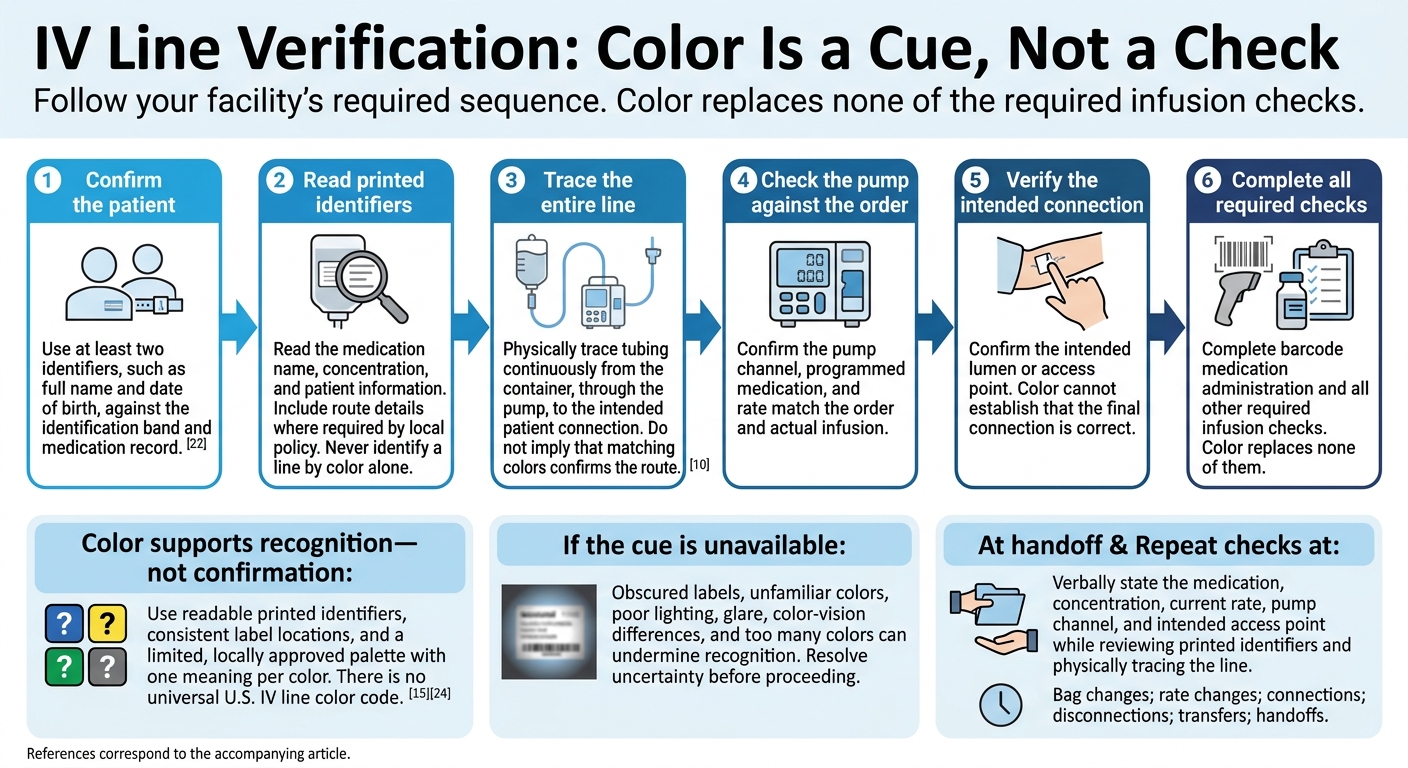
Color helps clinicians find infusion sources and tell tubing paths apart. It can speed up line finding, but that alone does not prove safer care. Color cues must be paired with bedside verification.
Use Color With Printed Identifiers
Color is a cue, not a check. Pair it with readable medication names, concentrations, and any patient ID or route details required by local policy. Place labels in consistent locations, such as near the pump and patient connection, as local policy directs. Use a limited, locally approved set of colors, with one meaning per color. Never assume there is a universal U.S. IV line color code.
Bedside Uses and Limits
Color helps staff recognize lines faster. It does not replace line tracing.
| Use | Practical benefit | Limit to address |
|---|---|---|
| Faster line finding | Helps clinicians recognize tubing paths, infusion sources, and pumps. | Hidden or similar-looking labels, poor lighting, glare, color-vision differences, and too many colors can cause confusion. Faster identification can still be wrong if tubing is mislabeled or connected incorrectly. |
| Local meaning and orientation | Gives staff consistent cues within a facility. | Meanings may differ across units or organizations. New, temporary, and agency staff need orientation. |
| Remaining error risk | Helps staff follow a line’s path. | Color cannot confirm the drug, concentration, patient, pump settings, compatibility, or final connection. |
Handoffs still require verbal and physical confirmation. State the medication, concentration, current rate, pump channel, and intended access point while reviewing printed identifiers and physically tracing the line. Never identify a line by color alone. If labels are obscured or colors are unfamiliar, treat the cue as unavailable and resolve uncertainty before proceeding.
Check the Medication, Line, Pump, and Connection
Follow the facility’s required sequence. Confirm the patient using at least two identifiers, such as full name and date of birth, against the identification band and medication record. Then read the printed medication, concentration, and patient information. Trace the tubing continuously from the container through the pump to the intended patient connection. This process is essential for preventing IV line entanglement and ensuring clear tubing paths. AHRQ describes tracing as a way to verify the bag, tubing, pump settings, and hookup.
Next, check that the pump channel, programmed medication, and rate match the order and actual infusion. Verify the intended lumen or access point. Complete barcode medication administration and all other required infusion checks - color replaces none of them. Repeat these checks at bag changes, rate changes, connections, disconnections, transfers, and handoffs.
Putting IV Line Safety Practices Into Use
These workflow steps bring the identification gains reported in research to bedside practice.
Standardize Labels, Training, and Handoffs
Once labels are standardized, keep them visible and easy to trace at the bedside. Include the approved labeling policy in orientation and competency checks for permanent, agency, travel, float, and newly assigned staff. Define label wording, placement, color conventions, and legibility, and ensure adequate lighting.
Trace lines and verify connections during handoffs and before every reconnection. Fully prepare one infusion before starting the next. Follow institutional policy and equipment instructions, and do not modify tubing or connectors outside policy.
Track safety outcomes separately from task time. Collect baseline data before rollout. Then track identification errors, wrong-line near misses, wrong-channel programming events, and administration errors alongside task time. Review medication-related harm, treatment delays, and IV complications as well. Use a consistent denominator, such as 1,000 IV administrations, to compare rates, and check for differences by unit and shift.
Separate Tubing and Keep Labels Visible
Route tubing with fewer crossings and labels facing outward. Where possible, keep tubing away from floors, wheels, walkways, and bed mechanisms. Leave enough slack for repositioning. Avoid bends, compression, blocked pump controls, and hidden connections.
A line organizer’s role in this workflow is limited to keeping tubing separated and labels exposed.
Using the Beata Clasp for IV Line Organization
BeataClasp describes the Beata Clasp as an organizer intended to separate tubing. Position it so labels remain visible. Do not use its yellow color as a medication code.
Before adoption, ask nursing, infection prevention, pharmacy, and biomedical engineering to review attachment points, tubing compatibility, cleaning, and equipment instructions. During a limited pilot, monitor label visibility, tracing completion, tangles, and any tubing tension or obstruction. Record these observations separately from medication errors and patient outcomes.
Conclusion: Workflow Gains Are Not Proof of Less Patient Harm
Color makes IV lines easier to identify, but it’s a cue - not proof that a line is correct. Pair color with printed names, concentrations, line tracing, and bedside verification. Keeping tubing organized also makes lines easier to trace.
Faster workflows don’t prove fewer administration errors or adverse drug events in routine care. In one study, participants misidentified about one-third of IV lines, even though labeled scenarios took about 1 minute less. Color coding can help with verification, but showing reduced patient harm requires clinical outcome data - not faster recognition alone.
FAQs
What should I do if IV line labels conflict?
Physically trace the line from the patient’s access point back to its specific source, such as the IV bag, infusion pump, or medication port. This check confirms that the correct medication is being delivered through the intended route.
Before giving any medication, check all connections and review your facility’s protocols or the patient’s documentation to confirm accuracy and prevent administration errors.
How can IV labels accommodate color blindness?
IV labels should pair clear text with color cues, not rely on color alone. Different lettering styles, varied font sizes, and capitalized medication names make information easier to read. Tall man lettering helps providers tell look-alike drug names apart, offering another way to verify medications beyond color. Consistent, standardized labeling protocols keep critical medication details readable, regardless of a provider’s ability to perceive specific colors.
What evidence would show color coding reduces patient harm?
Simulation studies show that color-coded systems help staff identify the correct medications faster and more accurately. In one ICU simulation, no infusion identification errors occurred. Clinical trials involving more than 55,000 anesthetics also reported no syringe swaps when drugs carried color-coded labels.
These findings support using color coding to help reduce line misconnections and medication errors through immediate visual cues.