
A cheap IV hook can cost more over time. If staff keep stopping to untangle tubing, clean lines that touched the floor, or fix pulled-out lines, the low upfront price stops looking so low.
Here’s the short version: standard IV hooks cost less to buy, but IV line organizers can cut staff time, cleanup, and line-related problems. In this comparison, I’m looking at five cost factors that shape total spend in U.S. care settings:
- Setup and line tracing time
- Line control
- Cleaning work
- Contamination risk
- Fall risk
The price gap is clear. A standard hook is often already part of the IV pole, while the Beata Clasp costs $22.70 to $24.95 per unit. But the day-to-day cost gap can matter more. If tubing hangs loose, crosses, or hits the floor, nurses spend extra time fixing it. That repeated work can add up across every shift.
Quick Comparison
| Cost factor | Standard IV hook | IV line organizer |
|---|---|---|
| Upfront price | Lower | Higher |
| Staff time | More manual line handling | Less line tracing and rework |
| Tubing control | Loose hanging lines | Lines held in place |
| Cleaning | Basic wipe-down, but loose lines can create more mess | Easy surface cleaning between uses |
| Contamination risk | Higher if lines touch floor or bedrail | Lower when lines stay secured |
| Fall/snag risk | Higher during movement or transfers | Lower when tubing stays routed |
My takeaway: if line issues happen often on your unit, the higher upfront spend can make sense. If line handling is light, a standard hook may still be enough. The rest of the article breaks down where those costs show up and when each option fits best.
Standard IV Hooks: Low Upfront Cost, Higher Workflow Dependence
Standard IV hooks are simple hanging points fixed to poles or other fixtures. They hold infusion bags while the tubing hangs freely below. The price is low, which is why they look like the cheapest choice at first. But that lower sticker price comes with a tradeoff: staff have to do more hands-on line management every time the setup is used.
Direct Costs of Standard IV Hooks
Standard IV hooks are inexpensive to purchase and easy to source, so they usually have the lowest upfront cost. On paper, that sounds like a win. In practice, the lower purchase price starts to matter less once staff time gets pulled into line handling during routine care.
Indirect Costs From Loose or Poorly Routed Tubing
The bigger cost shows up after the bag is hung. Standard hooks don't include any way to route or secure tubing, so lines can hang loose, brush the floor, or get tangled with nearby equipment. That matters because loose lines that touch non-sterile surfaces increase the risk of contamination and potential infection.
It also slows basic tasks down. If a nurse has to figure out which line goes to which port - especially during a shift change or while adjusting medication - manually tracing tangled tubing adds time to each interaction. Clinical observations note that untangling, reorganizing, and reinserting lines creates significant workflow inefficiency.
Those same loose lines can also turn routine patient movement into extra work.
How Hooks Can Increase Fall and Rework Risk
This issue tends to show up most during movement. When a patient sits up, gets out of bed, or is transferred to another unit, unmanaged tubing can drag, snag, or pull. That creates fall and snag risk for both patients and staff. It can also dislodge a line, which may then need reinsertion.
When the bed is raised, hook-only lines can shift, catch on equipment, or fall to the floor, forcing staff to pause and reposition them. So while the hook itself is cheap, the day-to-day handling around it often isn't.
That's where dedicated line organizers begin to earn back cost: faster setup, less cleanup, and fewer line-related interruptions.
IV Line Organizers: Higher Upfront Cost, Better Control Over Time
Dedicated IV line organizers cost more at the start, but they can pay off over time. Why? They cut the labor, cleanup, and rework that loose tubing tends to create.
Instead of letting tubing hang freely, these organizers use fixed slots or channels to keep each line visible and in place. That makes routine line management easier. And when staff handle lines less, they usually spend less time fixing tangles, cleaning up, or dealing with interruptions.
Direct Costs and Reuse Economics
The Beata Clasp costs more upfront than a basic hook, although bulk buying can lower the per-unit price. Because it is reusable and can be cleaned again and again, one unit can spread that cost across many patient stays.
The bigger financial upside, though, often comes from day-to-day workflow rather than the sticker price alone.
How Organizers Cut Time, Cleaning Burden, and Tangling
When each line has its own channel, nurses can see where each one goes at a glance. There’s no need to trace tubing by hand. That saves time and cuts hassle during routine care.
Its non-porous surface also wipes clean fast and avoids adhesive residue. No sticky mess. No extra cleanup step.
It also helps keep lines from touching the floor or getting pulled out of place during patient movement. That means less rework and fewer workflow slowdowns.
Relevant Example: Beata Clasp in U.S. Care Settings
In U.S. care settings, this kind of value stands out most when the organizer needs to move with the patient. The Beata Clasp attaches to hospital bedrails, stretchers, IV poles, and wheelchairs, so staff can use it across care transitions instead of only at a fixed bedside.
That matters. A unit that works at the bedside, during transport, and in home care does not need to be swapped out as often. Its reuse across those settings can reduce replacement frequency.
Adhesive-free organizers also avoid the tape-on-bedrail workaround, which can create infection-control and entanglement concerns. A reusable, adhesive-free organizer avoids that workaround while keeping lines organized. Those savings become clearer in a direct unit-by-unit comparison.
sbb-itb-f779e18
Side-by-Side Cost Comparison: Hooks vs. Line Organizers
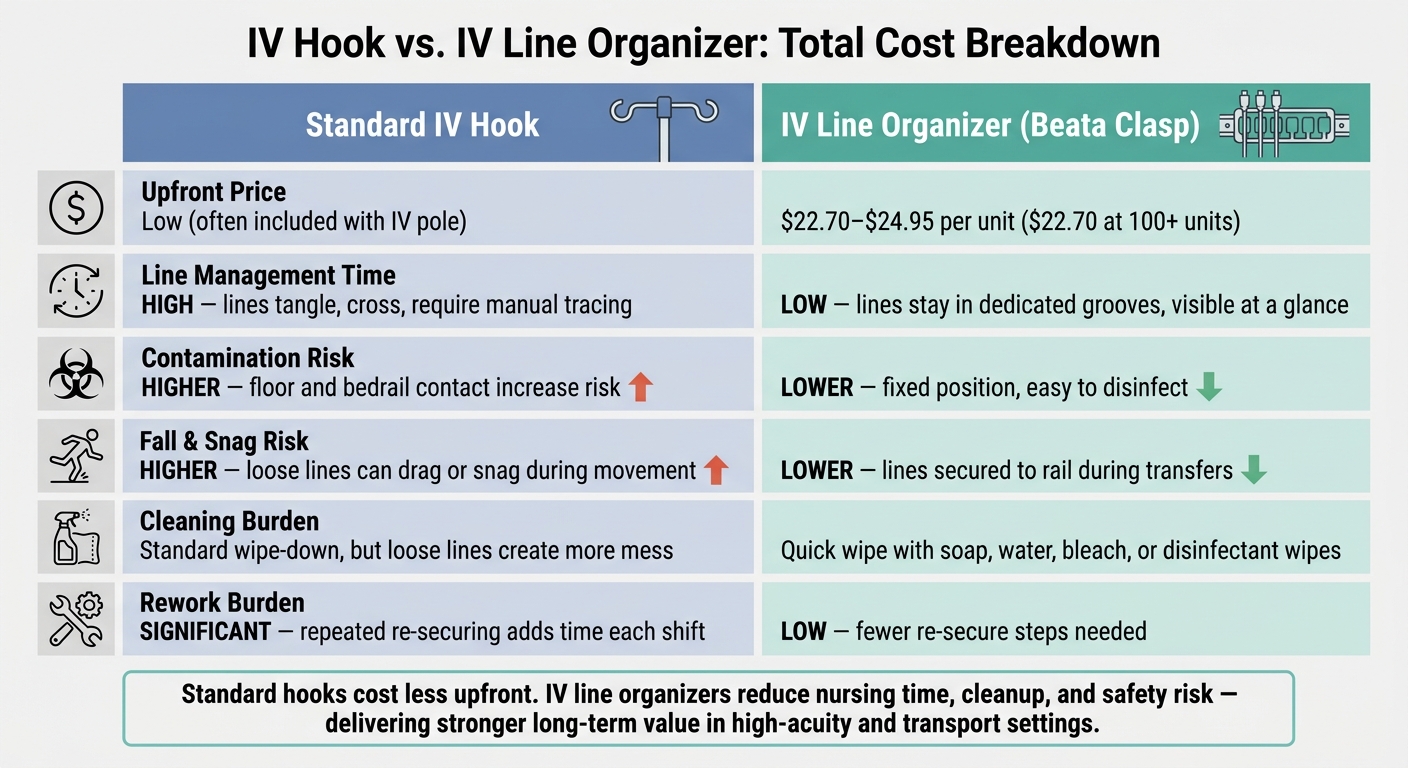
IV Hook vs IV Line Organizer: Total Cost Comparison
This table shows how a low upfront price can turn into more labor time and added safety risk later.
Direct Cost Comparison by Unit, Bed, and Replacement Cycle
| Feature | Standard IV Hooks | IV Line Organizer (Beata Clasp) |
|---|---|---|
| Purchase Price | Low, often included with the IV pole | $22.70–$24.95 per unit |
| Reuse Cycle | Fixed hardware | Reusable across multiple stays |
| Replacement Frequency | Rare, usually only if the pole breaks | Cleaned between uses |
| Cleaning Burden | Standard surface wipe-down | Soap, water, bleach, or standard disinfectant wipes |
Bulk orders bring the per-unit price down by about 9% at 100+ units, from $24.95 to $22.70. If you're outfitting a full unit, that drop adds up fast.
But purchase price is only one piece of the cost picture. Labor time and repeat work often create the bigger gap.
Indirect Cost Comparison for Nursing Time and Safety Events
| Cost Factor | Standard IV Hooks | IV Line Organizer (Beata Clasp) |
|---|---|---|
| Line Management Time | High; lines often cross, tangle, and require manual tracing | Low; lines stay organized in dedicated grooves |
| Fall Risk Exposure | Higher; loose lines can reach the floor | Lower; lines are kept secured to the rail |
| Contamination Risk | Higher; floor and bedrail contact increase risk | Lower; the fixed position is easy to clean |
| Rework Burden | Significant; repeated re-securing adds work | Lower; fewer re-secure steps |
The contrast is pretty simple: hooks may cost less at the start, but they can ask more from staff during care. When lines cross or drop, nurses have to stop, trace, and secure them again. That extra handling takes time and can chip away at workflow over the course of a shift.
When the Higher Upfront Cost Pays Off
The stronger case for the higher upfront spend shows up in ICUs, pediatric care, and transport, where line-control issues happen again and again. In those settings, paying more at the start can be easier to justify because the same problems keep coming back.
Conclusion: Which Option Delivers Better Long-Term Cost Results?
After looking at both direct and indirect costs, the takeaway is pretty simple: standard IV hooks are cheaper at the start, but total cost is shaped by more than the purchase price. Nursing time, cleanup, and safety risk all affect what you end up paying over time. And across the five cost factors - setup time, line control, cleaning, contamination risk, and fall risk - the gap between these two options is hard to miss.
Hidden labor adds up fast. If lines tangle, fall to the floor, or need reinsertion, staff time gets pulled into repeat tasks that don’t stop with a single incident. That’s where the extra cost starts to snowball.
The Beata Clasp costs $22.70 per unit at 100+ units, but it’s made to cut down on that repeat work. So while the upfront price is higher, it can still make financial sense when line management is a regular part of care. For units where staff handle lines often, the case for organizers becomes much harder to ignore.
The better option comes down to how often line management happens on the unit. In lower-complexity settings, standard hooks may still be the better fit. In high-acuity and transport settings, the line organizer is more likely to deliver stronger long-term value.
FAQs
When does a line organizer pay off?
A line organizer pays off when it cuts the time staff spend untangling lines, rearranging them, or putting them back in place. Instead of relying on repeated tape-based fixes, the Beata Clasp gives teams a better long-term option.
The payoff comes from saving time at the bedside, cutting rework, and helping prevent costly problems like patient falls, line dislodgement, and contamination during a patient’s hospital stay.
Which units benefit most from better line control?
Units caring for medically complex adults, pediatric patients, and patients in transport tend to see the biggest gains. These patients often face a higher risk of line impingement, dislodgement, and entanglement, so even small workflow fixes can make day-to-day care smoother and safer.
High-acuity areas like ICUs also stand out, especially when patients have multiple infusions or need frequent movement. In those settings, teams often see the strongest impact through better workflow, fewer identification errors, and lower risks of falls and contamination.
How should I compare total cost, not just purchase price?
Look past the sticker price and focus on the total cost of use. That means adding the day-to-day labor and the costs tied to risk. Nursing time spent untangling, reorganizing, or reinserting lines may seem minor in the moment, but it adds up fast and creates avoidable waste.
The cost of complications matters too. A single case of CLABSI can add about $48,000, and fall-related injuries can bring long-term financial strain along with reimbursement losses. Durable, antimicrobial options like the Beata Clasp can help cut waste, reduce rework, and lower the risk of infections and falls.