
Here’s the short answer: non-adhesive IV securement looks most useful for cutting line movement and accidental removals, especially with adult central lines, but the data is uneven and does not prove the same gains for falls, floor contact, or nurse time.
If I boil the review down, I get this:
- Best-supported use: subcutaneous anchor securement systems for adult CVADs
- Skin angle matters: adhesive-heavy setups can add MARSI/CASI risk, which matters more for older adults, kids, and people with fragile skin
- Tubing control is a separate issue: preventing IV line entanglement by keeping lines off the floor and away from bedrails may help with contamination and trip risk, but direct trial data is still limited
- Not all devices do the same job: catheter securement devices fix the line at the site; organizers like BeataClasp help with routing, not insertion-site fixation
- Buying on unit cost alone misses the point: the better question is total episode cost, including reinsertion, skin care, supply use, and nursing rework
A few numbers stand out. The article notes MARSI averages 13.0% and can reach 25%. It also lists BeataClasp at $19.95 per unit, $163.00 for a 10-pack eval set, and $467.50 for a 25-pack bulk set ($18.70 each).
If you’re reviewing options, I’d keep the decision simple:
- Match the device to the line type, mobility level, skin condition, and dwell time
- Separate securement from tubing organization
- Pilot locally before a full rollout
- Track dislodgements, skin injury, floor contact, and staff rework
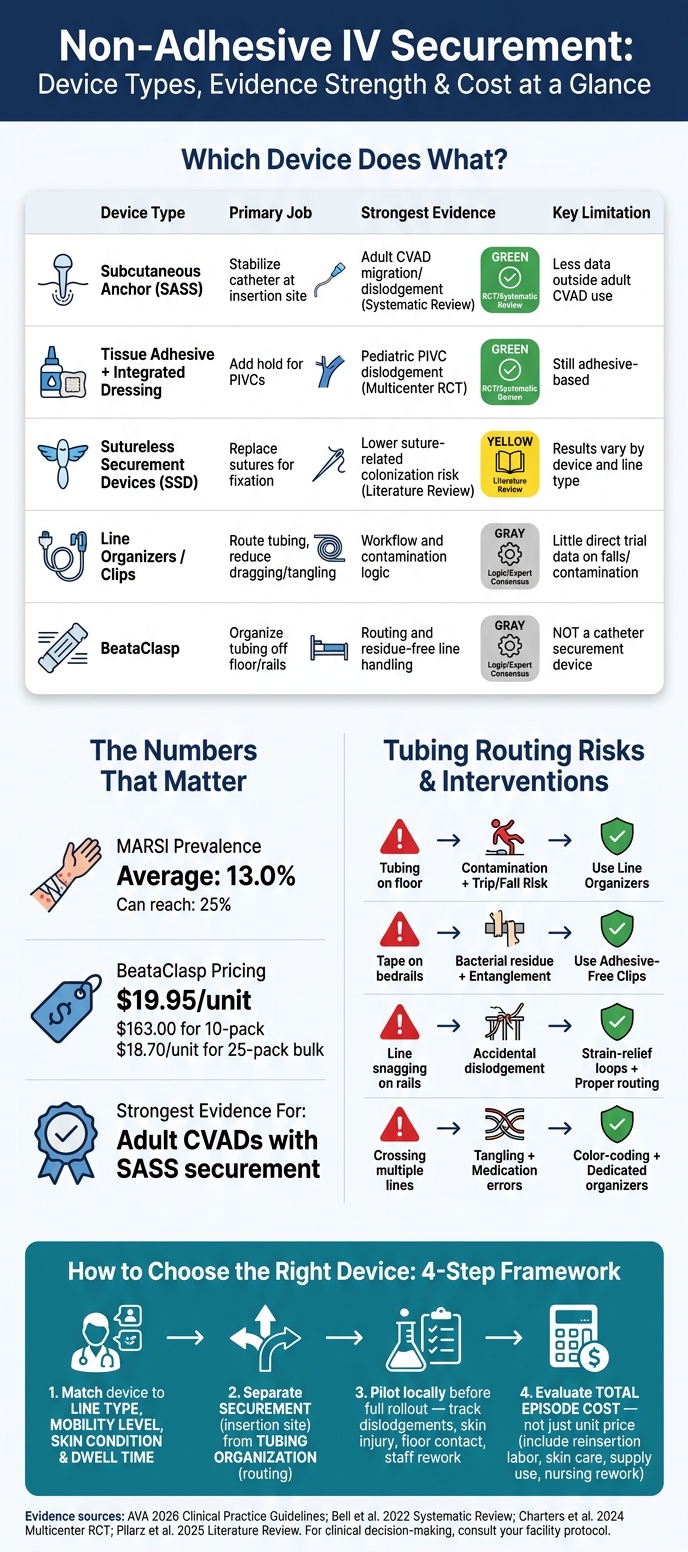
Non-Adhesive IV Securement: Device Types, Evidence Strength & Cost at a Glance
Quick comparison
| Option | Main job | Where support is strongest | Main limitation |
|---|---|---|---|
| SASS | Stabilize catheter at insertion site | Adult CVAD migration/dislodgement | Less data outside that use case |
| Tissue adhesive + integrated dressing | Add hold for PIVCs | Pediatric PIVC dislodgement | Still adhesive-based; not non-adhesive |
| Sutureless securement devices | Replace sutures for fixation | Lower suture-related colonization risk | Results vary by device and line type |
| Line organizers / clips | Route tubing, reduce dragging/tangling | Workflow and contamination logic | Little direct trial data on falls/contamination |
| BeataClasp | Organize tubing off the floor/rails | Routing and residue-free line handling | Not a catheter securement device |
So my read is simple: use non-adhesive securement where the evidence is strongest, use organizers for tubing control, and don’t treat those two jobs as the same thing.
sbb-itb-f779e18
Line Dislodgement and Catheter Failure: Findings From Trials, Reviews, and Technical Testing
What Controlled Testing Shows About Pull-Out Resistance and Stability
When pull-out resistance and migration are the main endpoints, AVA guidance says securement should match the patient and the line. That means looking at mobility, skin condition, anatomy, and expected dwell time. AVA also says tissue adhesive on its own is not enough for CVAD securement, may increase skin-injury risk in adults, and points to non-adhesive options such as SASS for line stability without added MARSI risk.
The same guidance also says adhesive enhancers, such as gum mastic liquid adhesive, can help in patients with a high risk of dressing lift from moisture or movement. But there’s a tradeoff: in patients with fragile skin, that extra sticking power can also increase the chance of skin damage.
That leads to the next issue: it’s one thing to see better resistance in controlled testing, and another to see the same result at the bedside.
What Clinical Studies Report on Unplanned Removals and Securement Failure
Clinical studies point in the same direction: fewer dislodgements. But the picture isn’t identical across catheter types or patient groups. The strongest data still come from adult CVAD studies. One systematic review found that SASS significantly reduced catheter migration compared with adhesive-based securement methods.
For peripheral lines in pediatric care, a multicenter randomized clinical trial found that tissue adhesive combined with integrated securement dressings led to fewer unintentional PIVC dislodgement events than standard transparent polyurethane dressings alone. A literature review also noted that sutureless securement devices reduce suture-related colonization risk.
| Securement Type | Care Setting | Primary Outcome | Key Result | Study Design |
|---|---|---|---|---|
| Subcutaneous Anchor (SASS) | CVAD (Adult) | Catheter Migration | Significantly reduced vs. adhesive | Systematic Review (Bell et al., 2022) |
| Tissue Adhesive + Integrated Dressing | PIVC (Pediatric) | Unintentional Dislodgement | Fewer events vs. standard polyurethane | Multicenter RCT (Charters et al., 2024) |
| Sutureless Securement (SSD) | Arterial Catheters | Infection/Colonization Risk | Reduces suture-related colonization risk | Literature Review (Pilarz et al., 2025) |
Taken together, these studies back up the stability argument, but the evidence base is still limited. Non-adhesive securement methods should not be treated as if they all perform the same way. Right now, support is strongest for adult CVADs, while pediatric PIVC data rest on one RCT, so broad generalization would go too far.
Falls, Line Entanglement, Contamination, and Skin Effects
How Tubing Position and Line Management Relate to Falls and Contamination
Even if the catheter stays put, poor tubing routing can still create safety problems. Securement at the insertion site is only part of the picture. The way tubing is routed can also affect dislodgement risk through snagging, floor contact, and crossed lines during normal patient movement.
When tubing ends up on the floor, it can pick up pathogens and turn into a trip hazard for patients and staff. Taping lines to bedrails brings its own problems too. It can leave behind residue that harbors bacteria and make entanglement more likely, which is why the Joint Commission discourages the practice. And when lines get tangled during turning, sitting up, or walking to the bathroom, that repeated tugging can increase the odds of accidental dislodgement.
Here’s the basic risk picture:
| Hazard | Possible Outcome | Intervention Type |
|---|---|---|
| Tubing on floor | Contamination; patient/staff trips and falls | Line organizers |
| Tape on bedrails | Bacterial growth in residue; line entanglement | Mechanical organizers; adhesive-free clips |
| Line snagging on rails | Accidental dislodgement; therapy interruption | Proper routing; strain-relief loops |
| Crossing multiple lines | Tangling; medication errors; flow obstruction | Color-coding; dedicated line organizers |
One simple fix is the strain-relief loop. That means making a small loop in the external tubing so any pulling force hits the loop first, not the insertion site directly.
Skin Integrity, MARSI, and Comfort in Adhesive-Sensitive Patients
The same friction and repeat handling that loosen lines can also wear down the skin. The 2026 AVA Clinical Practice Guidelines identify medical adhesive-related skin injury (MARSI) and catheter-associated skin impairment (CASI) as major risks with shared causes such as moisture, friction, repeat removal, and adhesives that are a poor match for the patient’s skin.
This matters even more for older adults and pediatric patients. The AVA guidelines recommend placing a sterile barrier film before the dressing to lower MARSI risk. They also recommend "slow, low-angle" removal techniques with skin support to help reduce skin stripping. For some CVADs, SASS is highlighted as an evidence-based option when adhesive-based securement is a concern.
Where BeataClasp Fits in the Risk Discussion
This is the part of the workflow where non-adhesive organizers can help. BeataClasp is a non-adhesive IV line organizer made to keep lines off the floor and routed neatly without leaving adhesive residue on rails or other surfaces. It is antimicrobial and latex-free, which can help in settings where line contamination and cleanup are regular concerns.
One point matters here: BeataClasp is a non-adhesive line organizer, not a catheter securement device. Its role is routing and contamination control, not insertion-site fixation.
Nurse Time, Workflow Burden, and Cost of Adoption
What Studies Say About Rework, Staff Time, and Interruptions
Safety gains matter most when they cut down the day-to-day mess that slows nurses down. Tangled lines and catheter migration don't just create risk. They also create extra work across an entire shift. Nurses end up untangling tubing, re-routing lines, and, in some cases, dealing with reinsertion. That takes time away from care.
"Line not running" alarms often trace back to tubing tension, kinks, or routing problems. Occlusion alarms and "line not running" calls interrupt nursing flow and add rework.
AVA recommends reassessing securement when dressing disruption, migration, or therapy interruption recurs. That reassessment adds more work too, especially when the same patient needs repeated attention over several shifts.
How to Compare Device Cost Against Total Episode Cost
This workflow burden is part of the actual cost of line failure. If a team looks only at unit price, they're starting in the wrong place. Unit price by itself misses the bigger picture. A better way to look at it is cost per episode: nursing labor for reinsertion, supplies used during replacement, skin treatment for MARSI or CASI, and disruption to therapy.
| Cost/Impact Factor | Adhesive-Based Workarounds | Non-Adhesive Organization |
|---|---|---|
| Labor (Maintenance) | High: frequent untangling and re-taping required | Lower: less repeated intervention to keep lines organized |
| Skin Integrity | Risk of MARSI and CASI from repeated adhesive use | Avoids adhesive contact for line organization |
For teams evaluating BeataClasp, the current pricing is $19.95 per unit, $163.00 for a 10-unit evaluation pack, and $467.50 for a 25-unit bulk pack, which comes out to $18.70 per unit.
A practical way to judge labor impact is to track rework events before and after adoption. That gives buyers something more useful than sticker price alone. Teams should still test any savings against local workflow and patient mix.
Evidence Gaps, Buyer Checklist, and Key Takeaways
Current Gaps in the Evidence Base
The research points toward non-adhesive securement, but some bedside outcomes still haven't been studied enough. Most of the published data looks at catheter stability, with a strong focus on adult CVAD studies.
That matters because a few day-to-day concerns still don't have direct trial support. Falls and floor contamination, for example, are still missing direct data. So buyers are left making a practical call: the case for line stability is strong, but the effects on falls, contamination, and workflow are less certain. Following essential IV line safety tips can help mitigate these risks during the transition.
Home care and highly mobile patients also don't show up enough in the literature. Nurse-time reporting is another weak area. Studies don't use one standard way to measure securement-related workflow burden, which makes side-by-side comparison shaky.
That's why local testing matters more than vendor claims.
Buyer Review Checklist for U.S. Healthcare Teams
Before moving ahead with a non-adhesive securement device, U.S. teams should check a few basics first:
| Review Area | What to Verify |
|---|---|
| Dislodgement evidence | Has the device shown a reduction in unplanned removals in peer-reviewed data? |
| Skin safety | Is it appropriate for fragile skin, adhesive sensitivity, or a MARSI history? |
| Contamination control | Does it help keep lines off the floor and reduce contact points during movement? |
| Compatibility | Does it fit existing catheter diameters, hub designs, and tubing configurations? |
| Infection-control alignment | Does it preserve insertion-site visibility under your protocol? |
| Workflow impact | Is it easy to apply and remove, and does it require competency validation? |
| Pilot data | Has it been tested locally before a facility-wide rollout? |
A small pilot can help teams check fit, cleaning, workflow, and line management before a full rollout.
Conclusion: What Decision-Makers Can Take From the Research
Put it all together, and the message is pretty clear: this is a case for targeted use, not a one-size-fits-all switch.
The evidence base for non-adhesive IV securement is uneven, but the pattern is steady. Catheter stabilization and dislodgement reduction have the strongest support, especially for SASS with CVADs. Skin-sparing gains matter most for patients with adhesive sensitivity or fragile skin. MARSI prevalence averages 13.0% and can reach 25%.
Falls and contamination prevention still sit in a gray area where clinical logic runs ahead of direct trial data. In plain terms, teams shouldn't assume those gains without tracking them.
Securement should match patient mobility, skin condition, and dwell time. For decision-makers, that means no single device will work for every patient or care setting. Local pilots, structured skin assessments, and total episode cost analysis are the best tools teams have right now.
FAQs
Which patients benefit most from non-adhesive IV securement?
Non-adhesive IV securement is especially useful for hospitalized patients with multiple lines, tubes, or drains. These patients often face a higher risk of line impingement, dislodgement, tangling, or floor contamination.
That includes medically complex adults, pediatric patients, and patients who need frequent transport. By keeping lines organized and off the floor, this approach can also help protect mobile patients and those at risk for falls.
How is tubing organization different from catheter securement?
Catheter securement keeps the catheter hub or tubing fixed to the patient’s skin. That helps limit movement at the insertion site and can reduce migration, kinking, or accidental dislodgement.
Tubing organization keeps the line length between the patient and the equipment under control. In plain terms, it helps stop tangling, keeps lines off the floor more often, and cuts down tripping risk.
What should a unit track during a pilot?
Track metrics tied to patient safety, clinical efficiency, and product performance. That includes tubing and line incidents such as dislodgement, removal, entanglement, and impingement.
It also helps to watch for skin integrity issues, nurse usability, ease of application, and the time it takes to manage or reorganize lines.