
My takeaway: follow catheter-specific aseptic care at insertion and every access - but don’t assume one step alone prevents infection. Start with hand hygiene, the right barriers, skin and connector disinfection, and prompt removal when a line is no longer needed.
A 2025 review covering 47 studies and 24,399 participants found uncertainty about individual sterile practices. Many were tested together, so I would separate recommended care from proof of each step’s effect.
Here’s what I focus on:
- Match care to the catheter: Central lines require more barriers than peripheral IVs.
- Check and act: Inspect sites and dressings, report infection warning signs, and give home caregivers clear instructions for getting help.
- Measure both: Track staff adherence and infection rates separately.
- Keep tools in perspective: <u>Tubing organizers such as BeataClasp do not replace aseptic care</u> or prove fewer infections.
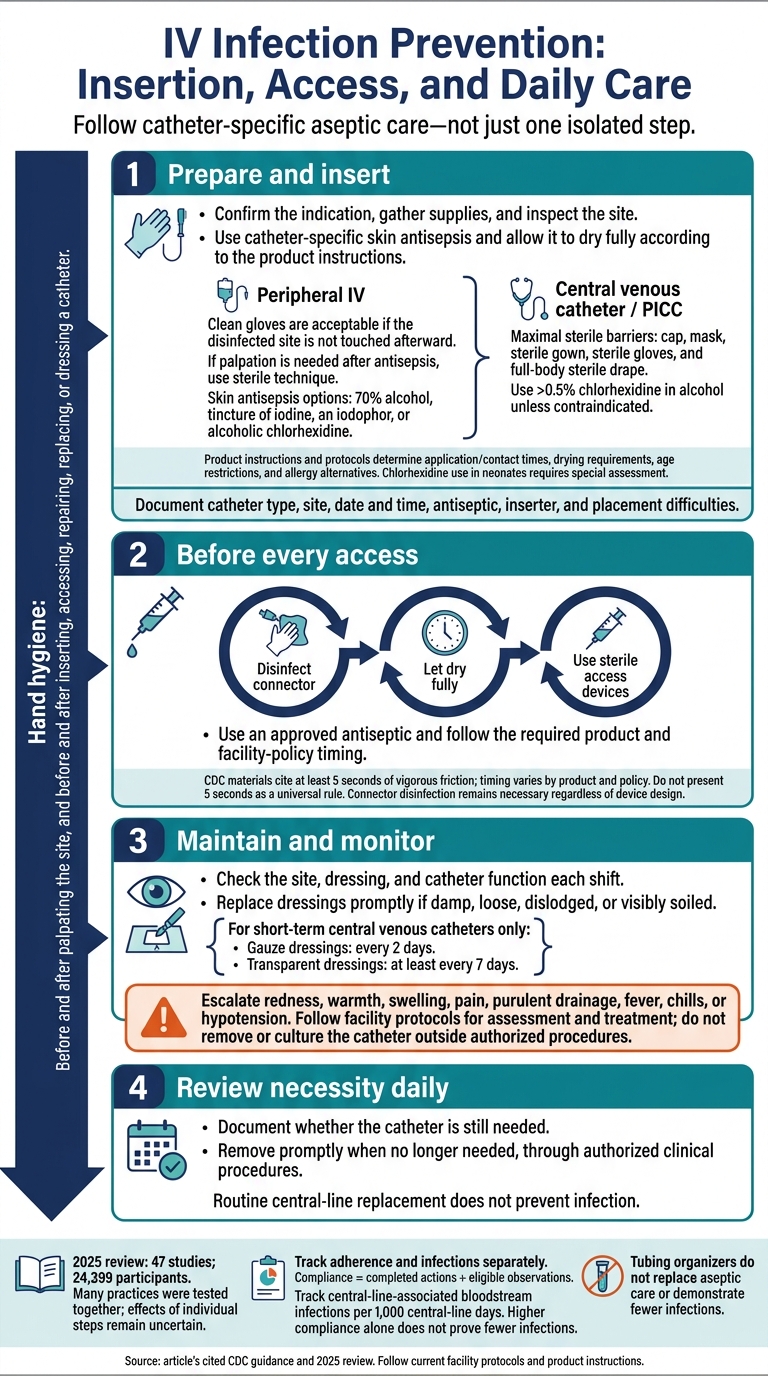
IV Infection Prevention: Insertion, Access, and Daily Care
The Complete Guide to Intravenous (IV) Cannulation LIVE DEMO | 2022 update
sbb-itb-f779e18
Research and Guidance for IV Care
The evidence is strongest when staff follow sterile steps consistently. CDC guidance calls for trained staff, observed competency checks, and prompt removal of catheters that are no longer needed. Routine central-line replacement does not prevent infection.
Every access, dressing change, and repair must follow the same sterile sequence for safer hospital environments.
Aseptic Technique and Sterile Barriers
For central venous catheter and PICC insertion, maximal sterile barriers include a cap, mask, sterile gown, sterile gloves, and a full-body sterile drape. For peripheral IV insertion, clean gloves are acceptable as long as the disinfected site is not touched afterward. If the site needs palpation after antisepsis, use sterile technique.
Perform hand hygiene before and after palpating the site, and before and after inserting, accessing, repairing, replacing, or dressing a catheter. Aseptic technique applies during both insertion and maintenance, not just when the catheter goes in. Standardizing line management ensures these protocols are followed consistently across the care team.
Skin Antisepsis, Connector Disinfection, and Dressings
Choose skin antisepsis based on the catheter type. For peripheral venous catheter insertion, CDC lists 70% alcohol, tincture of iodine, an iodophor, or alcoholic chlorhexidine as acceptable options. For central venous and peripheral arterial catheters, use a preparation containing >0.5% chlorhexidine in alcohol, unless contraindicated.
Protocols should specify the exact product, application and contact times, drying requirements, age limits, and alternatives for allergy or intolerance. Do not wipe antiseptic away early or cover wet skin unless the product label allows it. Before using chlorhexidine on neonates, account for gestational age, chronological age, and skin maturity.
Disinfect hubs, needleless connectors, and injection ports before every access. Let them dry fully, then use only sterile access devices. CDC materials cite at least 5 seconds of vigorous friction, though timing varies by product and policy. Acceptable antiseptics include alcoholic chlorhexidine, 70% alcohol, povidone-iodine, or an iodophor. Connector disinfection is still required regardless of device design.
The dressing provides another barrier against contamination. Apply sterile gauze or a transparent semipermeable dressing using aseptic technique, and check both the site and dressing routinely. Promptly replace any dressing that is damp, loose, dislodged, or visibly soiled. For short-term central venous catheters, CDC specifies gauze changes every 2 days and transparent dressing changes at least every 7 days. Gauze may be preferable while the site is bleeding or oozing.
IV Insertion and Maintenance Checklist
This checklist brings the earlier guidance into one workflow for insertion, access, and daily review. Studies often tested bundles of practices rather than individual steps, so it standardizes the full sequence through standardized protocols and training. Document each step at the point of care. Proper IV line management also prevents entanglement and accidental dislodgement.
| Practice | When used | Why it matters | CDC basis |
|---|---|---|---|
| Hand hygiene | Before and after every catheter task | Limits the transfer of organisms. | CDC |
| Skin antisepsis | Before insertion; during indicated dressing changes | Use the catheter-specific antiseptic and let it dry fully to reduce organisms at the entry site. | CDC |
| Gloves and barriers | Insertion | Protect the prepared site with catheter-specific barriers: clean gloves for peripheral IVs if the site remains untouched, sterile gloves for central, arterial, and midline catheters, and maximal sterile barriers for central lines. | CDC |
| Connector disinfection | Before every access | Scrub with an approved antiseptic for the required time, let it dry, and use sterile equipment to limit contamination. | CDC |
| Dressing assessment | Throughout catheter use | Replace promptly if damp, loose, or visibly soiled to keep the site protected. | CDC |
| Catheter necessity | Daily clinical review | Document whether the catheter is still needed and remove it promptly when it is not, limiting unnecessary catheter exposure. | CDC |
Insertion Steps by Catheter Type
Follow the same sterile sequence each time, adjusting only the barrier level for the catheter type. Before placement, confirm the indication, gather supplies, perform hand hygiene, and inspect the site.
At insertion, document the catheter type, insertion site, date and time, antiseptic, inserter, and any difficulty with placement.
After insertion, infection prevention depends on consistent maintenance at every access and every shift.
Maintenance, Monitoring, and Catheter Removal
Each shift, record the site's appearance, including redness, warmth, swelling, pain, tenderness, or drainage. Also document dressing condition, catheter function, and whether the catheter is still needed.
Escalate redness, warmth, swelling, pain, purulent drainage, fever, chills, or hypotension. Document the findings, vital signs, catheter status, actions taken, and whom you notified. Stop using the line when clinically indicated, and follow facility protocols for urgent assessment, cultures, treatment, and removal. Do not remove or culture the catheter outside authorized procedures.
Putting Research Into Practice
The evidence supports bundled practice more than isolated steps. The next priority is to standardize daily care and audit how consistently teams follow it.
Start with a baseline audit using a standardized checklist. Mark each item as completed, not done, or not applicable, and note any exceptions. Repeat audits on a fixed schedule. For recurring gaps, assign one owner and a deadline.
Report compliance separately from infection outcomes. Calculate compliance by dividing completed actions by eligible observations. Track central-line-associated bloodstream infections per 1,000 central-line days, using consistent case definitions, denominators, and reporting periods. Separate results by unit and catheter type when appropriate. Higher checklist compliance alone does not prove that infections have decreased.
Staff Training and Home Care Support
Assign insertion checks to the insertion team, maintenance checks to bedside or clinic staff, and surveillance to infection-prevention personnel. Check skills through direct observation. After missed critical steps, retrain staff and reassess their skills. Review audit findings together to see whether repeated gaps stem from knowledge, supplies, workflow, or staffing.
For home care, the treating team should specify who may access the line and provide written instructions and a clear way to get urgent help. Use demonstration and teach-back to check hand hygiene, dressing protection, and recognition of site changes or systemic illness. Clearly separate symptoms that require a prompt call from those that need emergency evaluation. Caregivers should not diagnose infection or change treatment on their own.
BeataClasp for Tubing Organization
BeataClasp is an IV line organizer for hospitals, ICUs, and home care. Its role here is tubing organization only. The manufacturer describes it as antimicrobial, latex-free, and easy to clean. Follow the manufacturer’s cleaning instructions and check that it fits the care workflow before use. These features do not prove fewer infections, falls, or line misconnections, and they do not replace aseptic care or sterile barriers.
Conclusion: Research Limits and Care Priorities
Lower infection rates do not prove that sterile technique caused the improvement. Observational and before-and-after studies may instead reflect changes in staffing, supplies, or care bundles. CLABSI, local infection, and contamination measure different outcomes. Findings from central-line studies also do not automatically apply to peripheral IVs or home care.
With mixed evidence, the safest approach is to follow the steps above consistently for catheter-specific insertion, maintenance, and monitoring.
Use continued monitoring to guide catheter-removal decisions, and remove unnecessary lines promptly. Line organizers, including BeataClasp, can help keep tubing organized. But they do not replace aseptic technique, dressing care, connector disinfection, or timely catheter removal.
FAQs
How can I distinguish IV irritation from infection?
IV irritation and infection can both cause redness, pain, warmth, or swelling. Pus-like drainage is a sign of local infection, which typically appears two to three days after insertion. Phlebitis may cause a cord you can feel along the vein. Infiltration may cause cool skin, tightness, or leakage.
Use TOUCH, LOOK, COMPARE: feel for temperature or hardness, check for drainage or discoloration, and compare the area with the opposite limb.
What should I do after a break in aseptic technique?
Replace contaminated equipment or solutions immediately. If a catheter was placed during an emergency or under nonsterile conditions, replace it using full sterile barrier precautions once the patient is stable. Follow all protocols for site assessment, securement, and hub disinfection.
The Beata Clasp keeps lines organized and off surfaces, helping reduce contamination and accidental dislodgement during patient movement.
How can I tell whether an IV care bundle works?
Count an encounter as compliant only when every required bundle element is complete. Measure adherence through specialist-led direct observation and checklist audits.
Track central line-associated bloodstream infection (CLABSI) rates per 1,000 device-days alongside adherence data to link gaps in practice with infection trends. Share consistent feedback across the unit during huddles or on quality dashboards to help keep standardized protocols effective.