
Tangled IV lines can hurt patients. They can lead to falls, pulled-out lines, wrong-line mix-ups, treatment delays, floor contamination, and, in rare cases, strangulation.
Here’s the short version:
- Loose tubing can trip patients during walking, transfers, or trips to the bathroom.
- Crossed or unlabeled lines can lead to mistakes when staff trace tubing or change infusions.
- Tubing on the floor can become contaminated, and open ends may need full replacement if they touch non-sterile surfaces.
- Risk goes up when patients have many lines, the room setup is crowded, or staff move fast during transport and handoffs.
- The main fixes are simple: trace every line, label patient-side ports, keep tubing secured, manage slack, and keep lines off the floor.
One stat stands out: only 9% of caregivers in a survey said they had received medical line entanglement education from healthcare providers. Another point is just as clear: 91.9% of IV mix-up events involved high-alert medications. That means line organization is not just about tidiness. It is about safe care.
If I had to sum up the article in one sentence, it would be this: most IV line tangle risks start with poor routing and rushed movement, and many can be cut with line tracing, labeling, securement, and better bedside setup.
What Research Shows About the Safety Risks of Tangled IV Lines
Research shows a clear pattern: when IV tubing isn't routed and secured well, patients face avoidable harm in three main areas - falls, therapy interruptions, and contamination.
Falls, Trips, and Unsafe Patient Movement
IV tubing that trails or hangs near the floor can become a trip hazard, especially during transfers and walking. If lines drag, loop, or sit where feet or equipment can catch them, safe movement gets harder. That can add to preventable falls.
Line Dislodgement, Infusion Errors, and Treatment Delays
Tangled tubing can lead to accidental line pulls, which may stop therapy in the middle of an infusion and force a painful restart. There's also a less obvious problem: line-identification mistakes.
Safety guidance says staff should trace each line from its source all the way to the patient's access site before making a connection or changing anything. In a rushed care setting, that sounds simple. In a tangled setup, it often isn't. Staff may follow the wrong line, miss a secondary infusion, or adjust the wrong pump. One comparison found that organized, labeled setups led to fewer identification errors and faster task completion than unlabeled, crossed configurations.
Contamination and Infection-Control Risks
IV tubing that sags between the pump and the patient can touch the floor, which may carry pathogens such as C. diff, MRSA, and VRE. If an open tubing end touches the floor or bed, infection-prevention guidance calls for a full tubing change because of suspected contamination.
Tangled lines can make this problem worse. The more twisted the setup, the more hands-on work it takes to sort it out. That extra handling can increase the chance of moving contaminants onto the tubing or access ports.
| Risk Area | Type of Evidence | Key Finding |
|---|---|---|
| Inpatient falls | Economic / quantitative | Trailing tubing contributes to fall risk during patient movement and ambulation. |
| Infusion errors | Observational / safety guidance | Tangled, unlabeled lines increase line-identification errors and slow safe tracing. |
| Floor contamination | Clinician-reported / infection prevention | Tubing that contacts the floor requires replacement due to suspected contamination. |
In most cases, these problems begin with routing and securement issues that could have been avoided.
sbb-itb-f779e18
Why IV Lines Become Tangled During Patient Care
IV tangles usually come down to two things: too many devices and poor bedside routing. And in most cases, the problem starts before the patient even moves.
Patient Complexity and Device Load
At the bedside, each added line makes tangling more likely. A patient with several infusions, drains, or monitoring leads can end up surrounded by IV tubing, ECG cords, oxygen saturation cables, and oxygen tubing all at once. It doesn't take much for that setup to become crowded and hard to control.
Some patients are at even higher risk because they're less likely to notice a line problem or fix it on their own. That includes young children and adults with confusion or cognitive impairment. Children between 6 months and 3 years old face higher risk because they're active and small, which gives lines more chances to wrap, twist, or bunch up. Cognitively impaired adults may not realize a line has looped around an arm or body part until it starts causing trouble.
The next section covers the tracing, labeling, and securement steps that stop these setups from turning into hazards.
Room Setup and Workflow Gaps
Room setup plays a big part too. Poor pole placement, too much slack, and lines stretched across walking paths all create easy tangle points. Then one simple movement, like getting up to use the bathroom or moving between the bed and a chair, can pull several lines together at once.
Workflow gaps make the situation worse. Rushed transfers and handoffs are common moments when things go wrong, especially if line tracing gets skipped. If staff move a patient without tracing and verifying the lines first, a problem may stay hidden until a line gets pulled loose or a pump starts alarming.
That’s why line checks before transfer or ambulation matter so much. They catch issues early, right at the point where IV line management best practices are supposed to step in.
Practices That Reduce Tangle-Related Harm
The risks above point to three practical controls: tracing, securement, and organized routing. Each one targets the same trouble spots behind falls, dislodgement, and contamination.
Line Tracing, Labeling, and Consistent Routing
Trace every line from the patient back to its source before you connect, disconnect, or move the patient. That simple step can catch crossed lines, hidden loops, and tubing that ended up in the wrong place.
Place a clear label at the patient-side port or Y-site. In a simulation study, labels plus organizers reduced identification errors to 0%.
It also helps to route lines the same way every time. When tubing follows a consistent path, crossings are easier to spot and line checks take less time.
Once lines are identified and routed in a consistent way, securement helps keep that setup in place during movement.
Securing Tubing and Preparing Patients for Safe Movement
Before any patient moves, do a quick line check. Make sure tubing is secured, slack is managed so lines aren't pulled tight or left looping near the floor, and nothing is hanging across a walking path.
Securement devices and arm boards can help stabilize peripheral sites, especially near joints or in patients who move often. Secure tubing without blocking the view of the site or the line path. For higher-acuity patients with multiple lines, a team-based approach to mobilization helps one clinician handle the tubing while the patient moves. And when IV access is no longer clinically needed, prompt removal cuts down the line burden.
In crowded setups, a physical organizer can help keep tubing separated and visible without taking the place of these steps.
Where an IV Line Organizer Fits Into a Safety Protocol
An IV line organizer is a practical add-on to tracing, labeling, and securement - not a substitute for any of them. It helps keep lines separated and visible during care and transport.
Beata Clasp is one example. It attaches to bedrails and uses four separate grooves to keep IVs, oxygen tubing, and feeding lines organized and visible from port to patient. Beata Clasp is an antimicrobial, latex-free, easy-to-clean IV line organizer for hospitals, ICUs, and home care, used to keep tubing separated, visible, and off the floor.
Key Takeaways and Conclusion
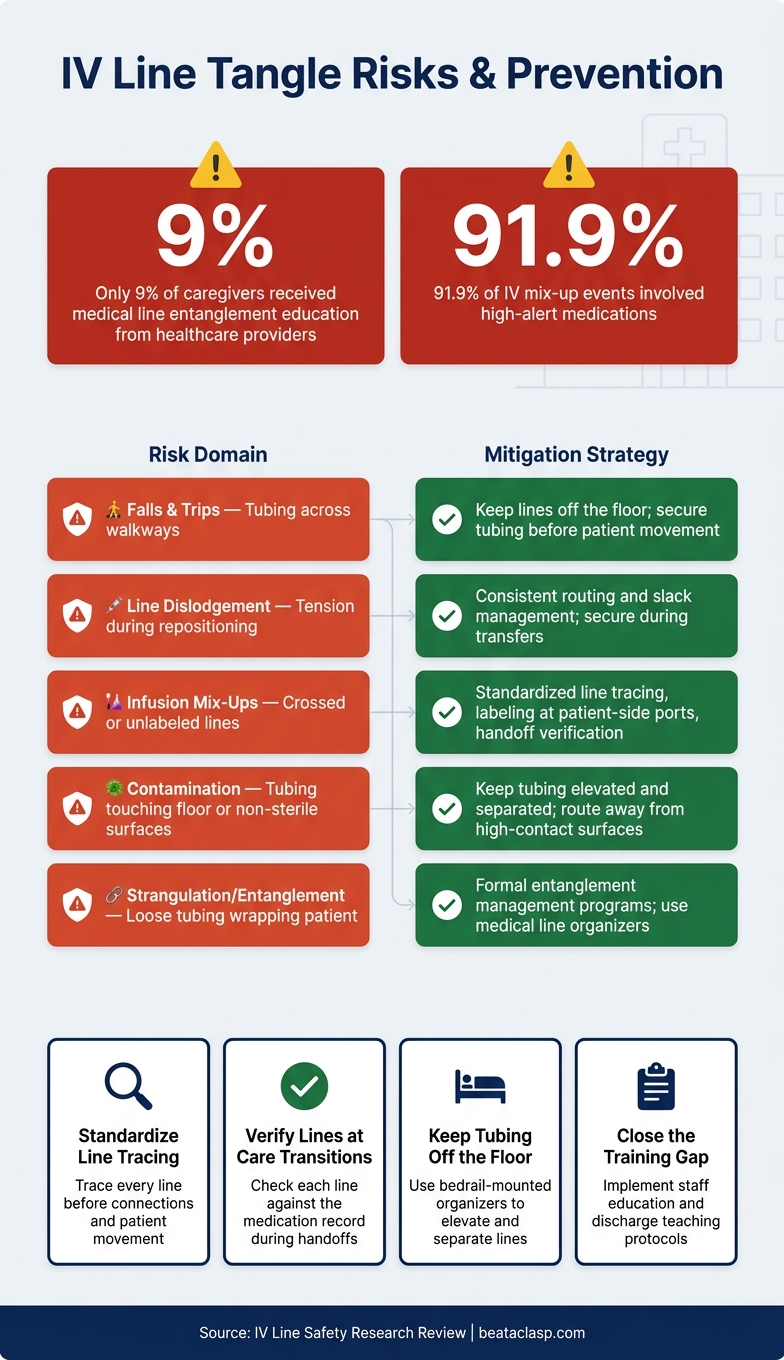
IV Line Tangle Risks & Prevention: Key Safety Data
The research points in the same direction: tangled IV lines create a safety risk that staff can often prevent. In most cases, the trouble starts with poor routing, weak securement, or rushed patient movement. The table below pulls together the main risks and the steps that help lower them.
Risk and Control Summary Table
| Risk Domain | Likely Mechanism | Level of Evidence | Mitigation Strategy |
|---|---|---|---|
| Falls & Trips | Tubing across walkways | Well established | Keep lines off the floor; secure tubing before patient movement |
| Line Dislodgement | Tension during repositioning or ambulation | Well established | Use consistent routing and slack management; secure tubing during transfers |
| Infusion Mix-Ups | Crossed or unlabeled bedside lines; high-alert medications were involved in 91.9% of IV mix-up events | Well established | Standardized line tracing, labeling at patient-side ports, and line-by-line verification during handoffs |
| Contamination | Tubing contacting the floor or other non-sterile surfaces | Observed in practice | Keep tubing elevated and separated; route lines away from high-contact surfaces |
| Strangulation / Entanglement | Loose IV tubing wrapping around the patient | Well established (FDA safety communication, February 2022) | Formal medical line entanglement management programs; use of medical line organizers |
Action Points for Healthcare Teams
For bedside teams, this comes down to four practical steps.
Standardize line tracing. Trace every line from solution to patient before connections, reconnections, and patient movement. Make line tracing part of each handoff, transfer, and room change.
Build line-by-line verification into transitions of care. When patients move between units or services, staff should visually and physically check each line against the medication administration record. That simple habit can catch misconnections before harm happens.
Keep tubing off the floor. Floor-level tubing creates both a trip risk and an infection-control problem. Bedrail-mounted organizers, such as Beata Clasp, can help keep lines elevated, separated, and easy to see.
Close the training gap. Written protocols, staff education, and discharge teaching matter, especially for patients who go home with devices.
FAQs
Who is most at risk from IV line tangles?
Patients at the highest risk are often those getting multiple infusions. The reason is pretty simple: the more lines a patient has, the easier it is for those lines to get tangled, mixed up, or used incorrectly. And when that happens, medication errors become more likely.
Other higher-risk groups include critically ill ICU patients, pediatric patients, disoriented adults, and patients being moved between departments or beds. In these situations, line snags and related complications tend to happen more often.
When should staff trace and verify every line?
Staff should trace and verify every line back to its source before connecting or disconnecting any device or infusion. That simple step helps confirm the right line and can prevent fatal misconnections.
Line verification should also happen during shift handoffs. At that point, teams should do a systematic check of active lines by visually tracing each one from the infusion pump to the patient’s access site.
How can hospitals keep IV tubing off the floor?
Hospitals can keep IV tubing off the floor with medical line organizers like the Beata Clasp. It attaches to bed rails, IV poles, or wheelchairs, so lines stay separated, organized, and lifted off the ground.
That matters more than it may seem. When tubing dangles or drags, it can pick up dirt, get caught during movement, or create a tripping risk. Keeping lines elevated helps cut contamination risk, lowers the chance of accidental dislodgement, and makes the care area easier to manage.
It can also help teams follow line-tracing protocols more consistently during patient movement and care transitions. In busy clinical settings, small tools like this can make line management a lot less messy.