
Falls in healthcare settings are a major safety concern, with over 700,000 incidents reported annually in U.S. hospitals. A key but often overlooked factor is the risk posed by tangled IV lines, commonly referred to as "spaghetti syndrome." Loose or disorganized tubing can cause trips, medication errors, and delays in care, impacting both patients and staff.
The solution? IV line organizers. These devices securely hold tubing, keeping it off the floor and neatly arranged. By reducing entanglement, they help prevent falls, save nursing time, and improve overall safety. Studies show that using IV line organizers eliminates line-related incidents and reduces the workload on healthcare teams.
Here’s what makes them effective:
- Design: Grooves hold tubing without pinching or blocking.
- Attachment: Fits bedrails, IV poles, and wheelchairs securely.
- Materials: Antimicrobial, latex-free, and easy to clean.
Research from Rush-Copley Medical Center highlights their impact: zero line entanglement incidents were reported when organizers were used, compared to frequent issues in standard care settings. By integrating these tools into daily protocols and training staff, healthcare facilities can tackle a preventable safety hazard head-on.
The Problem: IV Line Entanglement as a Fall Risk
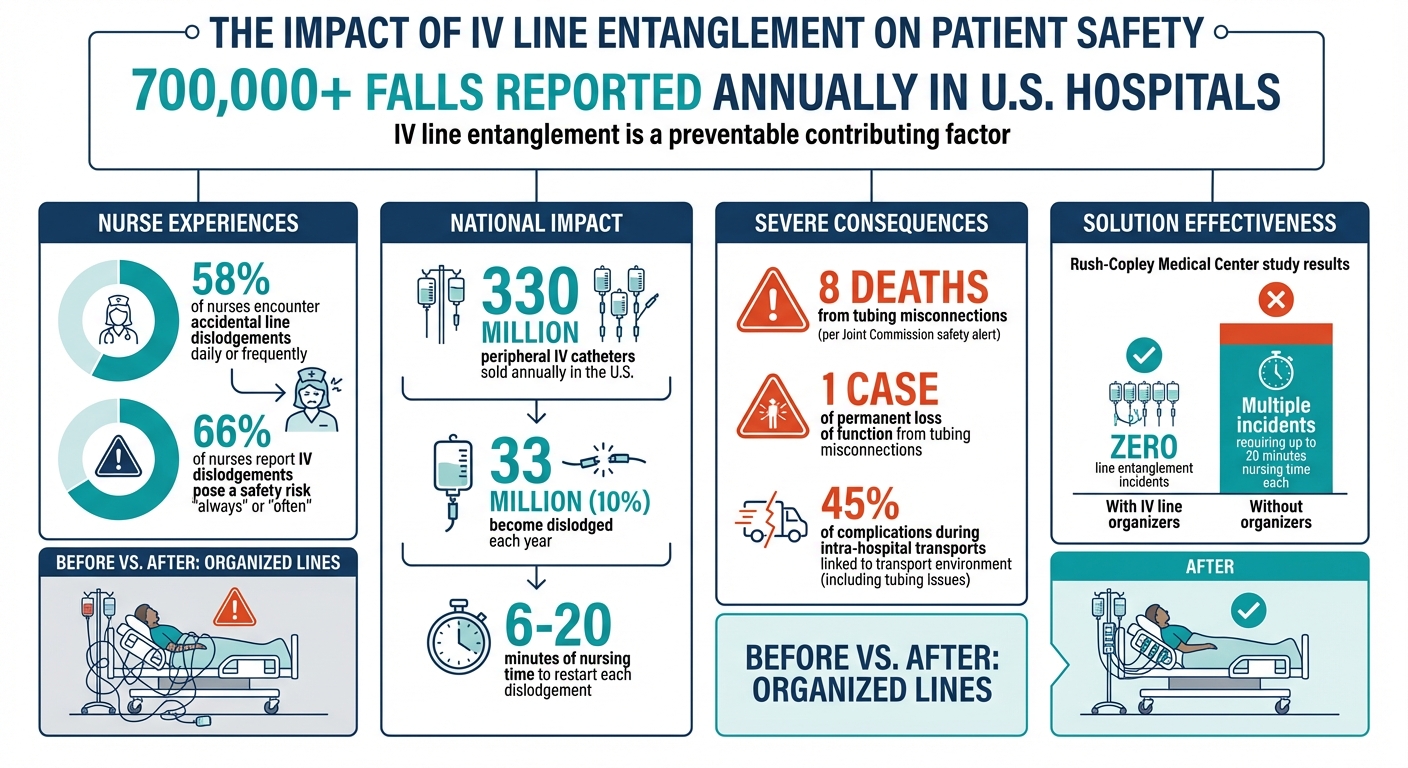
IV Line Entanglement Statistics and Impact on Patient Safety
Tangled IV lines pose serious risks to patient safety and create significant challenges for healthcare staff. One of the most immediate dangers is that loose lines can fall to the floor, becoming tripping hazards for patients attempting to walk to the bathroom or move within their rooms. However, the risks go beyond these visible obstacles.
Medical professionals often refer to this issue as "spaghetti syndrome" - a term that captures the chaotic tangle of lines, tubes, and cables around hospital beds. This disarray makes it difficult for staff to trace lines back to their sources, increasing the likelihood of medication errors and dangerous misconnections. In fact, The Joint Commission has highlighted the severity of this problem, reporting tubing misconnections that resulted in 8 deaths and one case of permanent loss of function in a single safety alert.
The scope of the issue is staggering. A survey of over 1,500 nurses found that 58% encounter accidental line dislodgements daily or frequently in their workplaces. These dislodgements often occur when patients roll over or stand up with tangled tubing. Out of the 330 million peripheral IV catheters sold annually in the U.S., approximately 10% - or 33 million - become dislodged each year. Restarting an IV line after dislodgement typically takes 6 to 20 minutes of nursing time, adding to the workload and reducing time available for other critical tasks.
At Rush-Copley Medical Center, a 157-bed hospital, researchers documented incidents of IV line entanglement in a control group. These events not only consumed valuable nursing time but also highlighted the broader safety risks. Alarmingly, 66% of nurses reported that IV dislodgements pose a safety risk "always" or "often".
For patients, the consequences go beyond physical harm. Many feel anxious or even fearful when caught in tangled lines, discouraging them from moving at all. This inactivity can lead to additional health complications. Meanwhile, healthcare workers face greater exposure to sharps injuries and bloodborne pathogens when they must frequently restart IVs due to accidental dislodgements. These combined risks make it clear: organizing IV lines effectively is critical for improving patient safety and reducing the burden on healthcare staff.
Solution: How IV Line Organizers Prevent Falls
IV line organizers are designed with four circular grooves that securely hold tubing without causing blockages. These organizers attach to bedrails, IV poles, or wheelchairs, keeping lines elevated and off the floor. By keeping tubing from falling, they directly address the risk of trips and falls caused by tangled IV lines. This straightforward design has been shown to reduce incidents of entanglement in healthcare settings.
For example, a study conducted at Rush‐Copley Medical Center between 2005 and 2006 compared nursing units using BeataClasp organizers with those relying on standard care. The results were striking: no line entanglement incidents occurred in the group using the organizers, while the standard care group experienced multiple events, some requiring up to 20 minutes of nursing time to resolve. Nurses also noted a safer work environment, as tripping hazards were significantly reduced.
Keeping IV Lines Off the Floor
These organizers securely attach to hospital bedrails (including thicker models like Hillrom® rails), IV poles, or transport equipment, ensuring that tubing stays elevated and neatly separated. Made from slip-resistant foam, they stay firmly in place without the need for adhesives, eliminating the need for unsafe taping solutions. By assigning each line to its own groove, the organizers prevent the "spaghetti syndrome" of tangled tubing, creating clear and organized pathways for both patients and staff. This setup is especially helpful when patients need to move, as it keeps tubing orderly and accessible.
Supporting Safe Patient Movement
When patients are being moved or transported, the grooves in the organizer ensure that tubing stays secure and avoids becoming pinched, dislodged, or tangled. This is vital, as a prospective audit revealed that 45% of complications during intra-hospital transports were linked to the transport environment, including tubing issues like entanglement or impingement. Additionally, the organized setup simplifies the process of tracing tubing back to its source, helping clinicians avoid misconnections. By reducing the risk of errors and complications, these organizers not only improve patient safety but also reduce the workload for healthcare staff.
What to Look for in IV Line Organizers
IV line organizers need to strike the right balance between durable materials and a practical design to help prevent falls effectively. When assessing these devices, pay attention to the quality of the materials and how easy they are to use. These two factors are critical for ensuring the organizer can handle the fast-paced demands of clinical settings and that staff will use them consistently. This focus ties back to earlier discussions on fall prevention, emphasizing the importance of reliability in challenging healthcare environments.
Material and Construction
Opt for organizers crafted from antimicrobial and latex-free materials. These features are essential for reducing the risk of healthcare-associated infections by preventing the growth of bacteria and mold.
Durability is key, so look for flexible materials like TES or styrenic-polyolefin blends. These materials are non-porous, making them easy to disinfect, and they hold up well under regular use. Additionally, an adhesive-free, friction-based design is ideal - it avoids sticky residue buildup, making maintenance simpler.
Usability and Compatibility
Ease of use is non-negotiable. The organizer should be straightforward, requiring minimal training for staff to operate confidently. It must securely attach to a variety of equipment, including:
- Bedrails up to 1.75 inches thick
- IV poles with a diameter of at least 1 inch
- Wheelchairs
To enhance safety and efficiency, the design should include adjustable grooves that accommodate tubing up to 5/8 inch in diameter. Dedicated channels for multiple lines are another must-have feature, as they help reduce trip hazards and minimize the chances of line management errors.
sbb-itb-f779e18
Using IV Line Organizers in Healthcare Facilities
Incorporating IV line organizers into healthcare settings requires thoughtful staff training and seamless integration into existing protocols. While their straightforward design reduces the need for extensive instruction, proper training ensures their effective use and maximizes their potential.
Training Staff on Proper Use
Start with a brief demonstration or conduct facility-wide training sessions. These should cover when and how to use the organizers, proper IV line maintenance, and essential infection control practices.
"Educate healthcare personnel regarding the indications for intravascular catheter use, proper procedures for the insertion and maintenance of intravascular catheters, and appropriate infection control measures." – CDC
Training should also address common unsafe practices, like taping medicine cups to bedrails to hold tubing, and showcase how organizers can prevent these workarounds. Staff must learn how to securely attach the organizers to bedrails or equipment, ensuring they are easy to clean and reposition. Only staff who demonstrate competence in IV line maintenance should manage these devices. Regular assessments can help ensure that protocols are consistently followed.
By focusing on proper training, healthcare facilities can reduce fall risks and maintain better control over IV line management.
Adding Organizers to Safety Protocols
Once staff are trained, the next step is integrating IV line organizers into safety protocols. These devices are most effective when combined with existing fall prevention measures rather than used in isolation. According to the CDC, "multifaceted strategies" or safety bundles improve adherence to evidence-based practices. This approach involves incorporating organizers into daily patient care routines, such as patient assessments that include evaluating line organization and catheter sites.
To standardize their use, ensure organizers are positioned to keep IV lines elevated, even when beds are adjusted. Make daily inspections of IV line organization a part of standard operating procedures. Additionally, encourage patients to report any discomfort or changes around their catheter sites. This not only helps maintain proper line management but also ensures critical items, like call buttons, remain accessible.
Conclusion: Reducing Falls with IV Line Organizers
IV line organizers play a key role in preventing patient falls by addressing the issue of tangled tubing. By keeping lines off the floor and avoiding the chaos often referred to as "spaghetti syndrome", these devices help minimize fall risks. Research shows that many tubing-related incidents - and the injuries they cause - can be avoided with proper line management tools.
Clinical results back up the effectiveness of these organizers. At Rush‑Copley Medical Center, for example, patients using the Beata Clasp had zero incidents of line entanglement. In contrast, patients without an organizer required 6 to 20 minutes of nursing time to untangle lines. This translates to smoother workflows and less frustration for healthcare staff.
Beyond fall prevention, organized IV lines make it easier to follow essential safety protocols, such as tracing lines from the patient to their source. This step is critical for avoiding medication errors and tubing misconnections. When lines are secured in dedicated grooves instead of being draped over bedrails or bundled together with improvised fixes, clinicians can quickly check and confirm connections during shift changes or patient transport.
For healthcare facilities aiming to improve fall prevention measures, IV line organizers offer a reliable, clinical-grade alternative to unsafe practices. The Beata Clasp, priced at $21.95 per unit, is one such tool that aligns with these goals. Evaluation packs and training bundles are also available, making it easy to integrate this solution into everyday workflows.
FAQs
How can IV line organizers help prevent patient falls in hospitals?
IV line organizers, such as the Beata Clasp, are designed to reduce the risk of patient falls by keeping tubing securely managed. These tools ensure IV lines stay neatly arranged, off the floor, and firmly attached to bedrails or IV poles. This setup minimizes tripping hazards and prevents line entanglement - two common issues that can lead to accidents in healthcare settings. By streamlining organization and enhancing safety, these devices contribute significantly to maintaining a safer environment for patients.
What should I consider when selecting an IV line organizer?
When selecting an IV line organizer, focus on features that improve patient safety and make daily use simpler. Opt for designs with grooves or channels that neatly hold tubing and keep it off the floor. Secure attachments for bedrails or IV poles are a must to ensure stability. Materials should be antimicrobial, latex-free, and easy to clean to maintain hygiene and reduce infection risks. High-visibility color-coding is another helpful feature, allowing for quick and accurate identification of lines, which minimizes the chance of errors. These considerations are particularly crucial in environments like hospitals, ICUs, or home care settings, where proper line management and fall prevention are critical.
How can healthcare facilities incorporate IV line organizers into their safety practices?
Healthcare facilities can improve patient safety by incorporating IV line organizers, such as the Beata Clasp®, into their daily practices. These tools help prevent falls and minimize line entanglement by keeping IV tubing secure and off the floor. They can be easily attached to bed rails, IV poles, or wheelchairs, making line management more efficient while reducing contamination risks.
To ensure successful implementation, facilities should consider purchasing organizers in bulk and providing hands-on training for staff. Including organizer usage in shift hand-offs and documenting it in electronic health records can further streamline the process. Regular compliance checks and audits can measure progress, with a focus on reducing line-related falls and infections as key metrics. By integrating these organizers into routine care, healthcare providers can foster a safer and more efficient environment for both patients and staff.