
Tangled IV lines, often called "spaghetti syndrome", are a major issue in hospitals, affecting patient safety and staff efficiency. Each year, 33 million IV dislodgements occur in the U.S., with 58% of nurses reporting frequent encounters. These tangles increase risks of catheter dislodgement, contamination, and falls, while also wasting 6–20 minutes of nurses' time per incident.
The solution? Tangle-free IV systems like the Beata Clasp keep lines organized, off the floor, and easy to trace. This reduces errors, prevents accidents, and saves time. Studies show that hospitals using these systems report zero tubing incidents, improved workflows, and reduced costs from preventable complications.
At $19.95 per unit, these systems are a cost-effective way to improve care and efficiency.
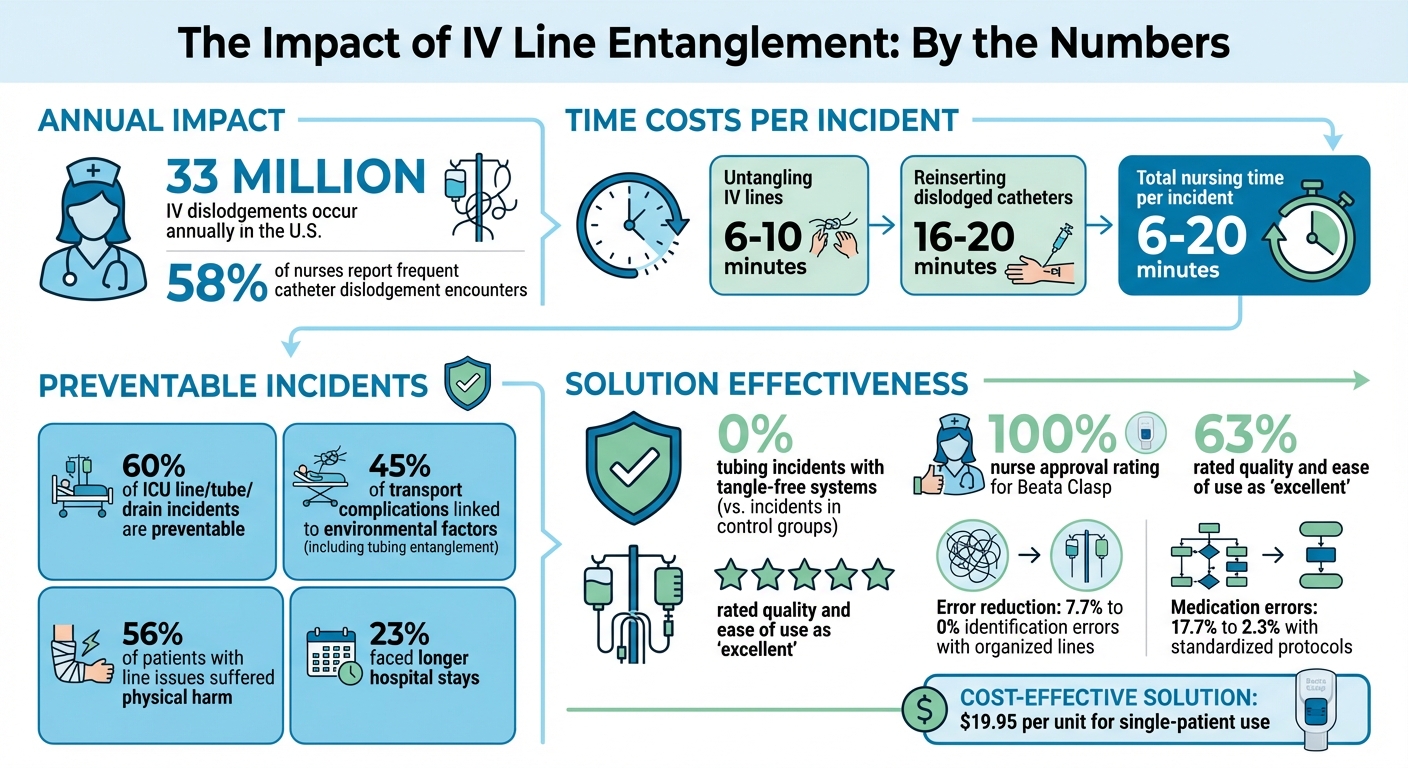
IV Line Entanglement Statistics and Safety Impact in Healthcare
The Risks of IV Line Entanglement
What Causes Tangled IV Lines
Tangled IV lines are a common problem in healthcare settings, and the reasons are fairly straightforward. The primary cause? Patient movement. Whether it’s rolling over in bed, reaching for something nearby, or walking to the bathroom while still connected to an IV pole, these everyday actions can quickly twist and knot the lines. The issue is even more pronounced with restless pediatric patients or disoriented adults who may tug on their tubing.
Transitions within the hospital are another high-risk moment. Moving patients between beds or transporting them to different departments often leads to lines snagging on bed rails, furniture, or equipment. In fact, nearly half - 45% - of complications among critically ill patients during intra-hospital transport are tied to environmental factors, including tubing entanglement. The problem escalates when patients require multiple infusions. Without proper organization, the proximity of multiple tubes can result in a tangled mess. These scenarios not only disrupt care but also introduce serious safety risks.
Safety Concerns from Tangled Lines
The dangers of tangled IV lines go far beyond being a nuisance. When lines snag on bed rails or equipment, the resulting tension can dislodge catheters. Alarmingly, 58% of nurses report dealing with catheter dislodgement on a daily or frequent basis.
Tangled lines that end up on the floor create a double threat. They pose tripping hazards for both patients and staff, while also increasing the risk of infection. Contact with non-sterile surfaces can transfer harmful pathogens directly to the patient. Each catheter dislodgement demands an unscheduled IV restart, which not only delays treatment but also raises the chances of infection.
"Caregiver/patient fall injury risks increase when medical tubing drapes on floors."
– Hartman, Jane H.; Bena, James F.; Morrison, Shannon L.; Albert, Nancy M., Journal of Infusion Nursing
Tangled lines also create confusion for clinicians. When IV lines are a jumbled mess, it becomes harder to trace them back to their source - a critical safety step recommended by ECRI to prevent medication errors and tubing misconnections.
Effects on Healthcare Staff and Workflow
The impact of tangled IV lines isn’t limited to patient safety - it also places a significant burden on healthcare staff. Nurses often have to spend precious time untangling and organizing tubing before they can safely administer medications or perform routine care. At Rush-Copley Medical Center, such incidents were found to take anywhere from 6 to 20 minutes of nursing time.
These delays add up fast. With an estimated 33 million IV dislodgements happening annually in the U.S. alone - and each replacement consuming 6 to 20 minutes - the strain on nursing efficiency is enormous. This extra workload contributes to staff fatigue and can lead to treatment delays, ultimately affecting the quality of patient care. What’s more, over 60% of incidents involving lines, tubes, and drains in intensive care units are deemed preventable, highlighting the pressing need for better line management practices.
How Tangle-Free IV Systems Improve Patient Safety
Preventing Catheter Dislodgement
Tangle-free IV systems are designed to keep catheters secure by using grooves or clasps that separate multiple IV lines, preventing them from tangling and potentially being pulled accidentally. By attaching tubing to bedrails or IV poles, these systems ensure the lines are neatly draped, minimizing the chance of snagging during patient movement.
This organized setup also makes it easier for medical staff to trace tubing from the pump to the patient, reducing the risk of accidental disconnections during routine care. Some systems even include safety release valves that disconnect under pressure, protecting the catheter's integrity.
"Catheters that were correctly secured become dislodged when greater forces are exerted upon the catheter than the securement method was designed to withstand."
– Linear Sciences
In addition to securing catheters, these systems enhance patient safety during movement.
Reducing Patient Falls and Injuries
By keeping IV lines elevated and organized, tangle-free systems eliminate tripping hazards for both patients and staff. Whether a patient is walking to the bathroom or moving around their room, the risk of snagging on wheelchairs, bed rails, or other equipment is significantly reduced.
A study conducted at Rush-Copley Medical Center, a 157-bed community hospital, highlighted the effectiveness of the Beata Clasp® organizer. In this prospective study, the control group experienced line entanglement incidents that required up to 20 minutes of nursing intervention, while the experimental group reported zero such incidents. Nurses credited the organizer for keeping lines off the floor, which played a key role in improving patient safety. Proper line management also prevents tubing from wrapping around a patient’s neck or limbs, a critical safety measure, especially for pediatric patients. These measures not only help prevent falls but also create a safer care environment overall.
Lowering Contamination Risks
Keeping IV lines elevated is essential for maintaining aseptic conditions, as floor contact is a major source of contamination. Tangle-free systems ensure tubing stays off non-sterile surfaces, reducing the risk of infection.
In cases where dislodgement does occur, advanced safety release valves provide an added layer of protection. Nancy Moureau, RN, PhD, explains:
"The safety release valve breaks away and seals off both sides of the tubing. This technology shuts off medication flow and preserves the catheter, while also allowing both the catheter and tubing to be protected in an aseptic manner."
– Nancy Moureau, RN, PhD
Operational Benefits of Tangle-Free IV Systems
Organized IV systems don’t just improve patient safety - they also bring key operational advantages that can make a big difference in healthcare settings.
Time Savings for Healthcare Staff
Nurses often spend valuable time untangling IV lines - time that could be better spent on direct patient care. Studies show that sorting out a single line entanglement can take 6 to 10 minutes, while reinserting a dislodged line requires 16 to 20 minutes. Compounding the issue, 58% of surveyed nurses report that accidental IV dislodgement happens daily or frequently in their facilities.
Tangle-free systems solve this by keeping IV lines neat and easy to manage. This makes it faster for staff to trace lines from the patient to their source, ensuring the correct tubing is selected during medication administration - a critical safety step often complicated by tangled lines. Additionally, these systems simplify patient transport, reducing risks and freeing up staff to focus on providing quality care. The result? A smoother workflow and safer environment for everyone.
Reducing Costs from Preventable Complications
IV line complications can be costly, and the expenses go beyond just replacing supplies. Frequent, unscheduled IV restarts add up, requiring extra labor and time from specialized nursing staff.
A study in an ICU setting found that over 60% of incidents involving lines, tubes, and drains could have been avoided with better management. Even more concerning, 56% of patients who experienced a line-related issue suffered physical harm, and 23% faced longer hospital stays as a result. By preventing these complications, tangle-free systems help reduce costs tied to extended hospitalizations, additional treatments, and even potential legal liabilities.
Improving Workflow Efficiency
The benefits of organized IV systems go beyond saving time and cutting costs - they also ease the workload for healthcare teams. Tangle-free setups eliminate many of the environmental hazards that disrupt workflow, especially in high-pressure areas like intensive care units.
Keeping IV lines organized and off the floor not only improves efficiency but also enhances safety for healthcare workers by reducing tripping hazards. A prospective audit found that 45% of complications during intra-hospital transport for critically ill patients were linked to environmental factors, including tubing entanglement. By addressing these issues, tangle-free systems allow staff to focus on patient care instead of troubleshooting preventable equipment problems. These operational improvements highlight the practical value of better IV line management in healthcare settings.
sbb-itb-f779e18
Beata Clasp: A Practical Solution for Tangle-Free IV Management
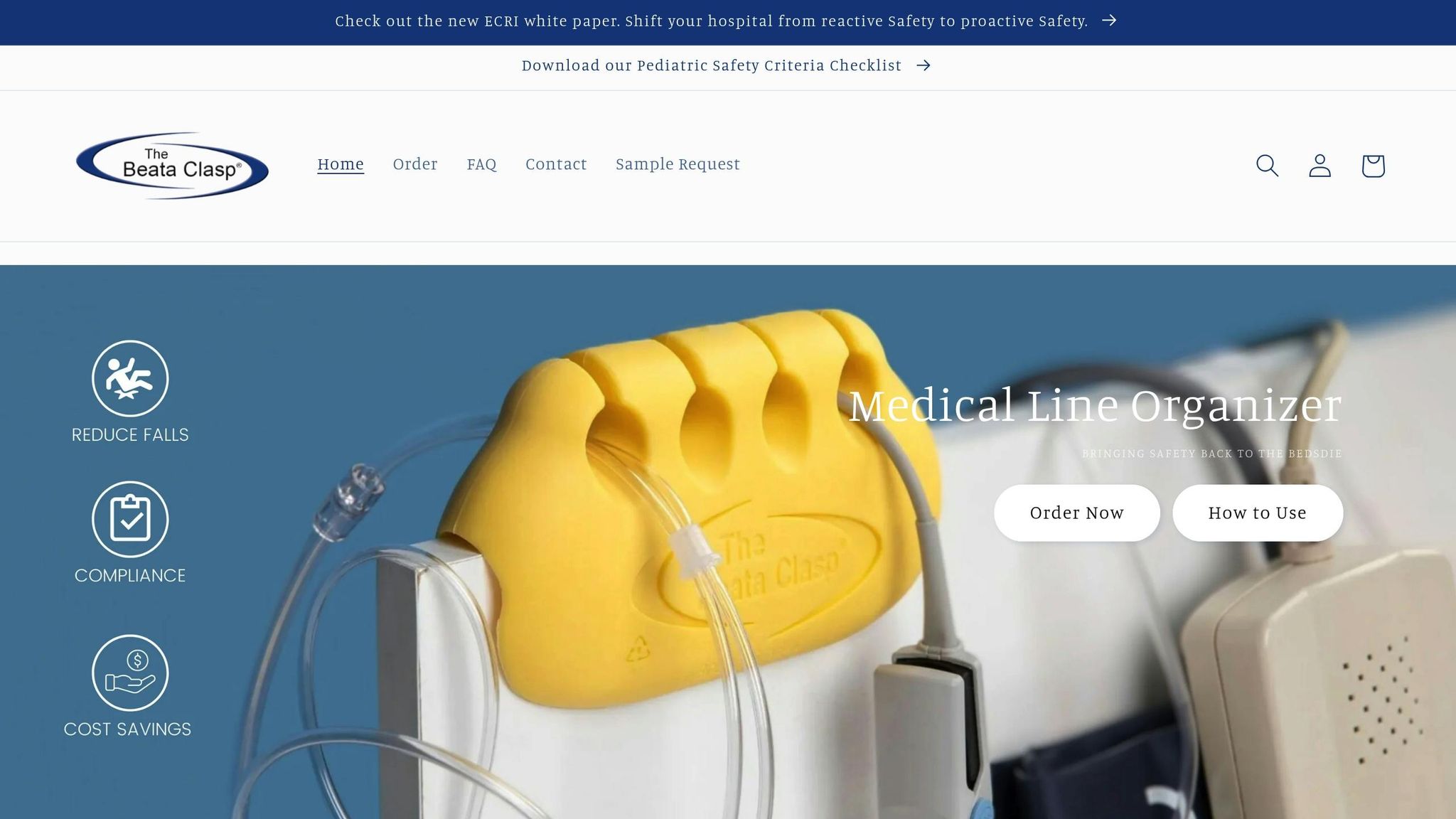
The Beata Clasp is designed to tackle a common challenge in healthcare: managing tangled IV lines. With its simple yet effective design, it keeps IV lines organized, off the ground, and easy to trace. This not only reduces the risk of contamination and patient falls but also improves efficiency for healthcare professionals.
Features of the Beata Clasp
Crafted from a flexible, latex-free styrenic thermoplastic elastomer (TES), the Beata Clasp incorporates an antimicrobial additive to resist bacterial and mold growth. It features four circular grooves that can hold tubing up to 5/8 inch (0.625") in diameter, allowing it to secure either one large tube or multiple smaller lines. The clasp easily attaches to bedrails, IV poles, or wheelchairs without the need for adhesives, making it adaptable for various care settings, including hospital ICUs and home care.
Its nonporous surface is built to withstand repeated cleaning with soap, water, bleach, or disinfectant wipes. While it isn’t suitable for autoclaving, the clasp meets CDC guidelines for noncritical reusable medical equipment. Additionally, its design simplifies the process of tracing lines from the patient back to the source, aligning with recommendations from ECRI and The Joint Commission.
Benefits for Patients and Healthcare Professionals
A study conducted at Rush-Copley Medical Center highlighted the effectiveness of the Beata Clasp. During the study, there were zero tubing incidents among patients using the clasp, while incidents were noted in the control group. Nurses also reported a significant reduction in time spent managing IV lines.
Feedback from the study was overwhelmingly positive - 100% of the nurses surveyed had a favorable impression of the Beata Clasp, and 63% rated its quality and ease of use as "excellent". Every nurse involved said they would recommend the device to colleagues. As stated in the study:
"The majority of nurses judged the Beata Clasp® effective in reducing the 'spaghetti syndrome', and believed it had a beneficial impact on patient safety and nursing efficiency."
In addition to preventing tangled lines, the Beata Clasp keeps call lights within easy reach and eliminates the need for improvised solutions like taping medicine cups to bedrails. This standardized approach minimizes bedside frustration and supports accurate line identification. Research has shown that organized lines result in zero identification errors, compared to a 7.7% error rate in unorganized setups. These improvements directly enhance clinical workflows and patient care.
Pricing Options for Healthcare Facilities
The Beata Clasp is available through several purchasing options to accommodate different needs. Individual units cost $19.95, while an Evaluation Pack of 10 units is priced at $163.00. For larger-scale needs, bulk orders of 25 units are available for $467.50 per pack. Designed for single-patient use, the clasp stays with the patient throughout their hospital stay and can even transition with them to home care if IV therapy continues.
Conclusion
Tangled IV lines can lead to serious problems like patient falls, catheter dislodgement, contamination, and delays in care. Studies have shown that keeping lines organized can significantly reduce errors - dropping identification mistakes from 7.7% to 0% when compared to unorganized systems.
The Beata Clasp provides a practical solution by keeping IV lines separated, off the floor, and easy to trace. Evidence from Rush-Copley Medical Center showed no tubing-related incidents with the Beata Clasp in use, and nurses unanimously recommended it.
Beyond enhancing safety, organized IV line management offers clear operational advantages. Facilities that adopted standardized protocols saw medication errors plummet from 17.7% to 2.3% over 18 months. Additionally, nurses saved valuable time - 6–10 minutes untangling lines and 16–20 minutes reinserting dislodged catheters - allowing them to spend more time on direct patient care.
At $19.95 per unit for single-patient use during an entire hospital stay, the Beata Clasp is a cost-effective way to address these safety and efficiency challenges. This approach to IV line management reflects a broader commitment to improving patient care and streamlining workflows.
FAQs
How do tangle-free IV systems help prevent catheter dislodgement?
Tangle-free IV systems are crafted to keep tubing neatly arranged and firmly secured, lowering the risk of loops or accidental pulls. By fastening the lines to an IV pole or bedrail, these systems help ensure that the catheter stays in place without unnecessary movement.
This stability plays a key role in preventing catheter dislodgement, enhancing patient safety, and reducing the likelihood of complications or discomfort.
How do tangle-free IV systems save hospitals money?
Tangle-free IV systems are proving to be a smart way for hospitals to cut costs by tackling common challenges like line entanglement, contamination, and patient falls. These systems not only save nurses from the tedious task of untangling lines but also help avoid medication errors and reduce the likelihood of adverse events - issues that often result in costly claims or longer patient stays.
Take the Beata Clasp as an example. This antimicrobial, latex-free IV line organizer keeps tubing neatly arranged and off the floor. By doing so, it minimizes the risk of contamination and injuries, streamlines workflows, and frees up staff to focus on what matters most: patient care. With improved efficiency and safety, hospitals can reduce spending on labor, disposable supplies, and infection control efforts. It's a practical solution that benefits both healthcare providers and patients.
How do tangle-free IV systems help prevent infections?
Tangle-free IV systems are designed to keep tubing neatly organized, cutting down on unnecessary handling and lowering the risk of contamination. These systems use closed, needle-free connectors to create a secure barrier, helping to block bacterial exposure and prevent intraluminal contamination.
By keeping things organized, these systems do more than just reduce infection risks - they also support safer and more efficient care across different healthcare settings, including hospitals, ICUs, and even home care.