
Poor IV line setup can lead to floor contact, line mix-ups, pump alarms, pullouts, and falls. In one hospital survey, 21% of falls over one year happened while patients were using an IV stand or pole. In ICU research, staff also reported hundreds of IV-line handling errors tied to disordered lines.
If I were picking an ergonomic IV line tool, I’d focus on seven things:
- Secure line hold without pinching tubing
- Clear line separation for tracing
- Attachment that stays put during movement
- Cleaning-friendly, latex-free materials
- One-hand, low-step use for staff and caregivers
- Fit across care settings like ICU, med-surg, and home care
- Line routing that keeps tubing out of the walking path
The article uses the Beata Clasp as the main example. It’s a 4-slot, adhesive-free IV line organizer that fits tubing up to 5/8 in. (15.875 mm) and mounts to places like bed rails, IV poles, stretchers, wheelchairs, and walkers. The main idea is simple: keep lines off the floor, easy to trace, and less likely to snag.
Quick Comparison
| What to check | Why it matters | What the article points to |
|---|---|---|
| Secure hold | Helps stop kinks, drag, and pullouts | Circular grooves that hold tubing without adhesive |
| Line separation | Makes tracing easier and cuts mix-ups | Separate routing for multiple lines |
| Movement support | Helps during bed-to-chair or stretcher transfers | Mounts to rails, poles, wheelchairs, and stretchers |
| Surface material | Supports cleaning between uses | Antimicrobial, non-porous, latex-free material |
| Ease of use | Saves steps during busy care | One-hand use and simple repositioning |
| Setting fit | Works from hospital to home | Use in ICU, med-surg, rehab, and home care |
| Fall-risk control | Keeps tubing out of the walking path | Upward routing to limit floor-level loops |
In other words: a good IV line tool should keep tubing secure, visible, cleanable, and out of the way while the patient moves.
Why IV Line Tool Design Matters in Daily Care
Poor IV line management creates risk that staff can avoid on every shift. When tubing drags on the floor, crosses over other lines, or snags on bed rails, care slows down. More than that, patients can get hurt. That’s why line design isn’t a small detail. It’s part of safe day-to-day care.
Floor contact is a clear infection-control problem. Guidance says IV tubing should be changed whenever contamination is suspected, including when an uncapped tubing end touches the floor. In plain terms, one brief floor contact can mean replacing the tubing and starting an infection-control response.
Line tracing mix-ups are another major issue, especially when a patient has several infusions running at once. Research on IV-line handling in intensive care units found hundreds of errors tied to disordered lines, including wrong-line connections, incorrect infusion rates, and lines not connected to the patient at all. When lines are easy to trace, staff can check the source of each infusion without second-guessing. That matters even more with high-alert medications like heparin or vasopressors, where one wrong connection can cause serious harm.
Accidental dislodgement becomes more likely when lines aren’t secured well, especially for high-risk patients such as neonates, toddlers, and confused or combative adults. Better securement can cut down on repeat insertions. Standardized labeling and an organized line layout also reduce identification errors and help staff move through multi-infusion tasks with less friction.
That’s the reason the first design feature centers on secure, non-occluding line organization.
1. Beata Clasp
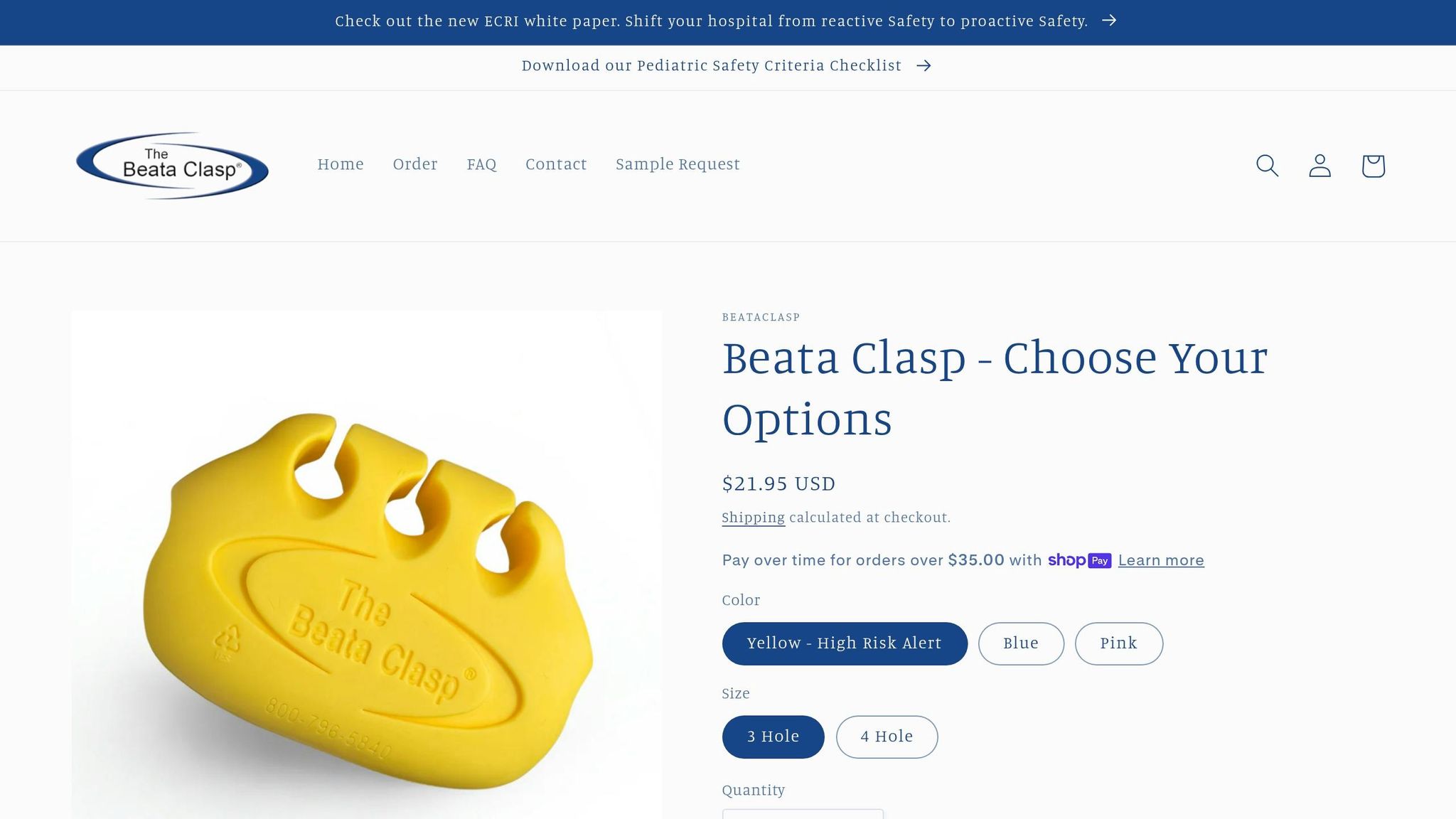
The Beata Clasp is a nurse-developed IV line organizer built to keep tubing elevated, separated, and easy to trace. In plain terms, it helps staff keep lines under control without pinching or blocking them.
It uses circular grooves to hold tubing in place without adhesive. Each of the four holes fits tubing up to 5/8 inch (15.875 mm) in diameter, and smaller lines can share one slot. That setup makes line routing simpler, especially when several tubes are in play at once.
The device attaches to hospital bedrails, IV poles, stretchers, wheelchairs, and walkers. That secure fit matters most when a patient needs to move and staff still need line control.
The Beata Clasp is made from styrenic thermoplastic elastomer with an antimicrobial additive and is 100% latex-free. It can be cleaned with soap and water, bleach, or EPA-registered disinfectant wipes, and it should not be autoclaved.
2. Secure, Non-Occluding Line Organization
Secure line organization matters for a simple reason: tubing needs to stay open and under control. If IV tubing kinks, bends too sharply, or gets trapped against a bed rail, flow can slow down or stop. That can delay medication delivery and set off pump alarms.
Good ergonomic tools should guide each line through its own separate channel, with a smooth curve that helps keep the tubing patent when a patient shifts or turns.
Keeping tubing off the floor during ambulation and transfers also lowers contamination risk.
When lines are separated and routed clearly, staff can trace them faster. That also cuts the risk of misconnection during multi-infusion care.
If an occlusion is suspected, staff should trace the tubing from the insertion site and check for kinks or closed clamps.
Once lines are separated and patent, the next step is making sure that setup holds as patients move.
3. Mobility-Friendly Attachment and Adjustability
Once lines are organized, the next test is simple: do they stay put when the patient moves? During transfers, an organizer needs to keep IV lines in place without adding pull, drag, or tangles. In practice, the attachment point makes a big difference.
Nurses report falls and near-falls during IV pole use, often when tubing catches or drags during transfers.
Beata Clasp attaches to standard bed rails, IV poles, wheelchairs, and stretchers, so it can move with the patient instead of fighting the movement. It can also be repositioned as the patient moves from bed to wheelchair or stretcher, and it does this without adhesives.
Care setups don’t all look the same. A patient may move from bed to chair, then to a stretcher, all in a short window. Beata Clasp stays secure during bed-to-chair and bed-to-stretcher transfers. It also supports optional reusable fastener ties for extra securement when a patient is moving across different surfaces.
Slack matters too. If tubing is too tight, it can pull. If it’s too loose, it can drop into the walking path. Beata Clasp uses flexible grooves that hold tubing up to 5/8 inch (0.625 in) in diameter, which helps preserve range of motion without creating tension.
After each transfer, staff should reset the routing so lines stay elevated and clear of the walking path. In plain terms, that means repositioning the organizer during transfers to keep tubing up and out of the way.
That same mobility-friendly securement also helps with safer cleaning and infection control.
4. Infection-Prevention Materials
Once a tool travels with the patient, it also needs to hold up under repeated cleaning. At that point, material choice becomes a safety matter, not just a look-and-feel decision.
Go with a non-porous, antimicrobial, latex-free surface that can be wiped down with standard disinfectants. Beata Clasp fits those needs and works with bleach, soap and water, and EPA-registered disinfectant wipes.
Antimicrobial materials can help limit microbial growth between cleanings, but they do not replace disinfection. The CDC classifies bedside organizers like these as noncritical reusable medical equipment, which means they should be cleaned and disinfected after use, especially when they’re shared between patients or visibly soiled.
In mixed-patient settings, latex-free tools are the safer pick. It also matters to follow the manufacturer’s cleaning instructions. Beata Clasp should not be autoclaved.
That same no-fuss design also makes the tool faster for nurses and caregivers to use during busy shifts.
sbb-itb-f779e18
5. Ease of Use for Nurses and Caregivers
Once lines are secure and mobile, staff still need a tool that works fast during routine care. A well-designed IV line tool should cut steps, not add more. It secures lines without tape or extra setup, and staff can use it with one hand. That keeps routine line management moving during busy shifts.
High-visibility color also makes line tracing faster during checks and handoffs. That visual cue supports accurate medication delivery and helps lower fall and injury risk when patients are moving.
It also cuts down on untangling and line reset time. That matters most when care shifts across units, during transport, and on home visits.
6. Use Across Different Care Settings
IV line tools work best when they fit into each stage of care without forcing staff to switch routines. The goal is simple: use the same line-management approach from admission through discharge.
Beata Clasp is built to stay with one patient from admission through discharge, which supports steady line organization across settings.
Its adhesive-free design, flexible grooves for tubing up to 5/8 inch (15.875 mm), and cleanable surface make it practical in different care environments. That matters in the hospital, but it also matters after discharge. Once patients go home, they and their families often have to manage lines on their own. In that setting, keeping tubing organized during normal movement and rest can make day-to-day care feel a bit less chaotic.
In the ICU, Beata Clasp helps keep multiple lines visible and separated, even with other equipment nearby.
That same steady routing can also help reduce trip hazards as patients move.
7. Trip and Fall Prevention Design
The last safety check is simple: do the lines stay out of the walking path?
Trailing IV tubing is a real fall risk. One hospital survey found that 21% of falls over one year happened while patients were using an IV stand or pole. When tubing hangs low, it can turn into an easy snag point. A line might wrap around a foot, catch on a walker, or get pulled by a wheelchair caster. That can throw a patient off balance or even yank a catheter from its insertion site.
Beata Clasp deals with this by routing lines upward instead of letting them drop near the floor. Its circular grooves hold tubing in place without adhesives, so lines stay close to the patient's body and out of the walking path.
This is most important during bed exits, bathroom trips, and chair transfers. Before any of those movements, a quick line check helps: make sure the tubing is gathered, routed upward, and clear of any floor-level loops.
Feature Comparison at a Glance
The table below sums up the main ergonomic features and what each one does. It gives you a fast way to see how the parts fit together in day-to-day care.
| Feature | Beata Clasp |
|---|---|
| Line Capacity | 4 holes; fits tubing up to 5/8 in (15.9 mm) in diameter; holds multiple lines per hole |
| Separation Method | Flexible, non-occluding circular grooves keep lines separated and visible. |
| Attachment Points | Compatible with standard bedrails, stretchers, and IV poles. |
| Antimicrobial | Yes - styrenic thermoplastic elastomer (TES) with antimicrobial additive |
| Latex-Free | Yes - suitable for latex-sensitive patients and staff |
| Cleaning Compatibility | Soap and water, bleach, or EPA-registered disinfectant wipes; non-autoclavable |
| Key Safety Benefit | Helps keep tubing elevated and organized to reduce contamination, entanglement, and trip risk. |
| Best Fit Settings | Hospitals, ICUs, and home care |
Think of this as a quick matching tool. If your team needs line separation, simple mounting, and cleaning options that fit normal care routines, this chart makes the fit easy to spot.
Matching Features to Your Care Setting
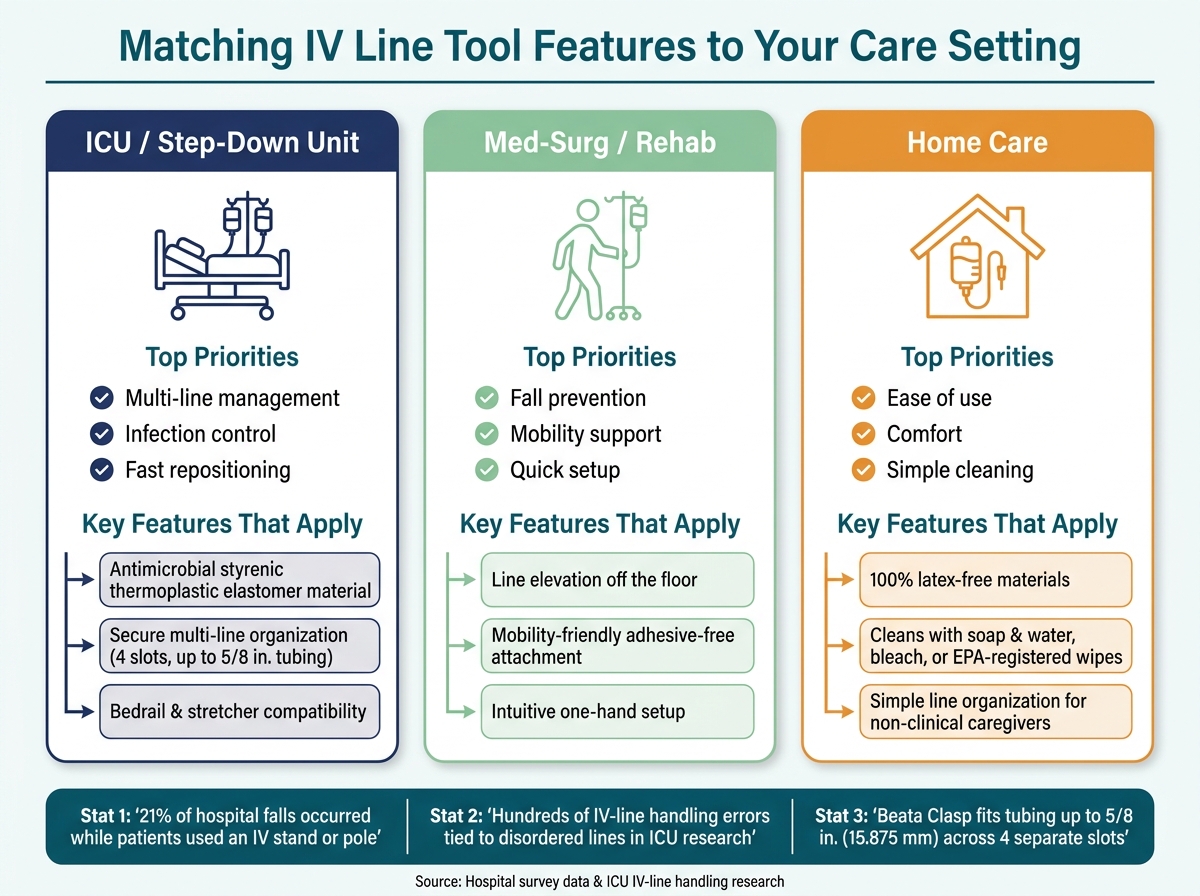
Ergonomic IV Line Tool Features: Care Setting Match Guide
Different care settings ask for different things from IV line tools. A setup that works well in an ICU may feel like overkill in home care. So the goal is simple: match the tool to the setting.
ICUs and step-down units need secure multi-line organization and surfaces that are easy to disinfect. These patients often have several lines running at the same time, and staff may need to move them fast between the bed and transport.
Med-surg and rehab floors need a setup that's easy to read at a glance. Tubing should stay elevated off the floor, setup should be fast, and rotating staff should be able to understand the layout without stopping to figure it out.
Home care calls for the simplest setup of all. Patients and family caregivers usually aren't clinical professionals, so the tool should work without special technique. Materials should hold up to common household cleaning with soap and water or bleach wipes. It also needs to stay comfortable during sitting, sleeping, and overnight infusions while keeping tubing off the floor and away from pressure points.
Use the table below to line up each care setting with its top priority.
| Care Setting | Top Priorities | Key Beata Clasp Features That Apply |
|---|---|---|
| ICU / Step-Down | Multi-line management, infection control, fast repositioning | Antimicrobial materials, secure multi-line organization, bedrail/stretcher compatibility |
| Med-Surg / Rehab | Fall prevention, mobility support, quick setup | Line elevation off the floor, mobility-friendly attachment, intuitive setup |
| Home Care | Ease of use, comfort, simple cleaning | Latex-free materials, easy cleaning, simple line organization |
Conclusion
These features address the line-management issues that interrupt care day after day. Ergonomic IV line tools help keep tubing off the floor, cut down on tangles, and lower the chance of accidental pullouts by keeping lines secure and easy to see. The result is safer patient movement, easier line tracing, less contamination risk, and less staff time spent fixing tubing problems.
Beata Clasp puts those features into day-to-day use. It uses antimicrobial, latex-free materials, stays in place without adhesives, cleans with little effort, and works across hospitals, ICUs, and home care. Picking an ergonomic IV line organizer that matches the care setting can help cut preventable bedside incidents.
FAQs
How does an ergonomic IV line tool reduce fall risk?
Ergonomic IV line tools help cut fall risk by keeping tubing organized, separated, and off the floor. That matters during patient movement, when loose lines can tangle fast and turn into a trip hazard.
They also keep lines secured to bedrails, IV poles, or wheelchairs. As a result, tubing is less likely to snag, get caught on nearby equipment, or be pulled out by accident.
What makes an IV line organizer safe for multiple lines?
An IV line organizer helps make multiple lines safer by keeping each one in its own designated space. That means less tangling and a much easier time tracing a line back to its source.
It also keeps lines neat and off the floor, which helps cut down on tripping hazards, contamination risks, and accidental disconnections when a patient is moved.
How should an IV line tool be cleaned between uses?
To support infection control, ergonomic IV line tools can be cleaned with common hospital-grade disinfectants. Their surfaces are made for easy wipe-downs and fit standard facility infection-prevention protocols.
For routine cleaning or maintenance, use only the cleaning agents approved by your healthcare facility. That helps protect the material and keeps the tool in good condition.