
My takeaway: early mobility may help some patients recover, but more activity is not always better - and IV organizers have not been shown to prevent falls or save staff time. In the TEAM trial, potential mobility-related adverse events affected 9.2% of patients receiving intensive mobilization versus 4.1% receiving usual care.
In this research summary, I separate what mobility studies show from what line-control products still need to prove:
- Mobility: Results vary by patient group, activity level, and usual care.
- Line control: Screening, preventing IV line entanglement, assigning staff roles, and checking devices frame the safety workflow before, during, and after movement.
- BeataClasp: Product features and favorable feedback from eight nurses do not establish fewer snags, dislodgments, contamination events, or falls.
- Local testing: Track line events, patient tolerance, staff minutes, and total costs against baseline data.
<u>The key distinction:</u> better mobility outcomes do not prove that a line organizer caused them. I focus on measured results - not assumed gains. This is a research summary, not clinical guidance.
What Early-Mobility Research Shows
Function, Hospital Stay, and Survival
Earlier ICU rehabilitation studies reported better function at discharge, greater strength at ICU discharge, more standing, longer unassisted walking distances, and higher rates of discharge home. But a 2025 nurse-led meta-analysis found no pooled improvement in mobility, body function, strength, or mortality.
Results vary with the patients studied, therapy dose, and usual-care intensity. In TEAM, greater activity did not significantly improve days alive and out of hospital at 180 days, ventilator-free days or ICU-free days at day 28, mortality, or other long-term outcomes.
Adverse Events During Mobility
Potential mobilization-related events - arrhythmias, blood pressure changes, or desaturation - occurred in 34 of 371 patients (9.2%) receiving intensive mobilization, compared with 15 of 370 (4.1%) receiving usual care (P = 0.005). These counts are per patient, not per session. Seven patients in the intensive-mobilization group had serious adverse events: five arrhythmias, one desaturation episode, and one cerebrovascular accident. In usual care, one patient had a serious adverse event: a desaturation episode.
These findings support careful screening, monitoring, and predefined stop criteria - not a blanket judgment that mobility is unsafe. They also do not establish fewer falls, line snags, or accidental removals. Those outcomes need clear definitions and separate reporting. Safety results from staffed, monitored ICU trials should not automatically extend to wards or home care, home care, or patients excluded from the trials.
These safety signals also support keeping IV lines, drains, and cables under control during movement. Line checks and line control are part of mobility safety, not a separate task.
Study Results and Limits at a Glance
The table brings the main outcomes and study limits into one view.
| Citation and year | Design, sample, and population | Intervention and comparator | Main findings and effect estimates | Key limits |
|---|---|---|---|---|
| Cardiac-surgery review, 2021 | Systematic review/meta-analysis; 5 studies, 652 patients | Early mobility versus study-specific comparison care | No statistically significant overall effect after accounting for heterogeneity | Small evidence base; limited applicability to mixed ICU populations |
| Nurse-led mobility review, 2025 | Systematic review/meta-analysis; critical-care patients | Nurse-led protocols versus comparison care | ICU stay shorter by 1.813 days (95% CI, −3.072 to −0.555); hospital stay shorter by 2.622 days (95% CI, −5.122 to −0.123). No significant pooled improvement in mobility, body function, muscle strength, or mortality | Heterogeneous measures; safety denominators unavailable in the supplied summary |
| TEAM, 2022 | Randomized trial; 750 mechanically ventilated adults, 49 sites, 6 countries | Intensive active mobilization plus sedation minimization versus usual ICU care | Similar ventilator-free and ICU-free days at day 28; days alive and out of hospital at 180 days: 143 vs 145, difference −2.0 days (95% CI, −10 to 6; P = 0.62). Mortality: 22.5% vs 19.5%; OR 1.15 (95% CI, 0.81–1.65). Potential mobilization-related events (arrhythmias, blood pressure changes, or desaturation) occurred in 34 of 371 patients (9.2%) vs 15 of 370 (4.1%), P = 0.005 | Multicomponent intervention; usual care included rehabilitation; limited generalizability beyond participating ICUs |
Statistical significance does not equal clinical importance. A shorter stay may matter, but its value depends on discharge readiness and function - not days alone. Reviews may also include overlapping primary studies, so their findings should not count as independent confirmations.
For local evaluation, track functional outcomes alongside session-level falls, line snags, accidental device removal, aborted sessions, and staff minutes per mobilization. The findings above do not establish improvements in those measures. These mixed results are especially relevant when patients move with IV lines, drains, and cables attached.
sbb-itb-f779e18
Medical Mythbusters – Is It Safe To Sit/Mobilize Patients with Femoral Catheters?
Line Management Throughout Mobility
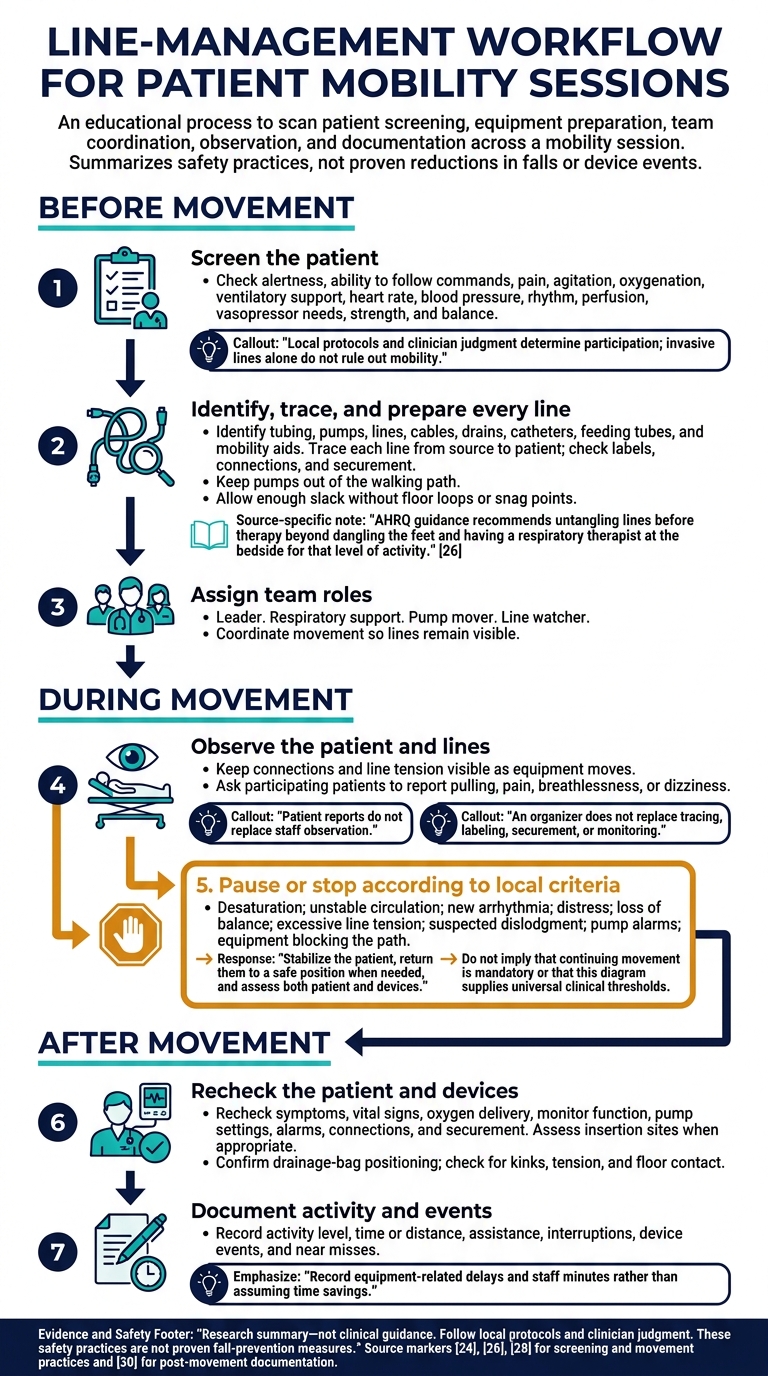
IV Line Management Before, During, and After Mobility
Mobility outcomes depend on how movement is carried out. Line management needs a step-by-step process before, during, and after movement to address snags, interruptions, and unsafe movement.
Before Movement: Screen Patients and Trace Lines
Before mobility, screen the patient and prepare every attached device. Check alertness, ability to follow commands, pain, agitation, oxygenation, ventilatory support, heart rate, blood pressure, rhythm, perfusion, vasopressor needs, strength, and balance. Local protocols and clinician judgment determine whether the patient can participate; invasive lines alone do not rule out mobility.
Identify all tubing, pumps, lines, cables, drains, catheters, feeding tubes, and mobility aids. Trace each line from its source to the patient, checking labels, connections, and securement. Keep pumps out of the walking path. Leave enough slack for movement without creating floor loops or snag points. AHRQ guidance recommends untangling lines before therapy beyond dangling the feet and having a respiratory therapist at the bedside for that level of activity.
Once the patient is cleared, coordinate the team so everyone moves together and every line stays visible.
During Movement: Assign Roles and Watch Lines
Before moving, assign a leader, respiratory support, a pump mover, and a line watcher. Keep connections and line tension in view as equipment moves with the patient. Ask patients who can participate to report pulling, pain, breathlessness, or dizziness - but patient reports do not replace staff observation. An organizer can help, but it does not replace tracing, labeling, securement, or monitoring.
Pause or stop according to local criteria for desaturation, unstable circulation, new arrhythmia, distress, loss of balance, excessive line tension, suspected dislodgment, pump alarms, or equipment blocking the path. Stabilize the patient, return them to a safe position when needed, and assess both the patient and devices. Tubing is only one hazard; these steps are safety practices, not proven fall-prevention measures.
After movement, check device function and record any interruptions.
After Movement: Check Devices and Record Events
Recheck symptoms, vital signs, oxygen delivery, monitor function, pump settings, alarms, connections, and securement. Assess insertion sites when appropriate. Confirm drainage-bag positioning and check for kinks, tension, or floor contact.
Document activity level, time or distance, assistance, interruptions, device events, and near misses. Record equipment-related delays and staff minutes rather than assuming time savings. Consistent records help teams review snags, interruptions, and unsafe movement locally.
BeataClasp and Local Line-Control Testing
Within that workflow, units can test whether a line organizer makes tubing easier to see, reduces snags, and saves staff time.
Manufacturer-Stated Features and Uses
The Beata Clasp is an IV line organizer designed to keep tubing visible and off the floor during care and movement. The manufacturer describes it as soft, flexible, and latex-free, with an antimicrobial additive and a nonporous surface. It attaches to bedrails, IV poles, wheelchairs, or walkers. These features do not prove fewer falls, contamination events, dislodgments, or staff-time savings.
Use it only if it fits the unit’s tubing, pumps, dressings, and mobility equipment. Placement must not compress tubing, hide insertion sites, interfere with pump alarms, create traction, or make lines harder to identify.
The manufacturer says the device can be cleaned with soap and water, bleach, or standard disinfectant wipes, but not autoclaved. Follow the current instructions for use and confirm approved disinfectants and contact times. Work with infection-prevention staff to set criteria for cleaning between uses, inspection, and replacement. Antimicrobial material does not replace hand hygiene or aseptic catheter care.
Claims vs. Evidence
A manufacturer-hosted summary describes a small process-improvement project at Rush-Copley Medical Center. All eight surveyed nurses reported favorable impressions, but the project did not support conclusions about preventing tubing incidents or reducing nursing time. Staff acceptance provides feedback on implementation - not proof of clinical benefit.
The test is whether the device changes measurable bedside outcomes, not whether it looks useful.
| Area | Claim or evaluation question | Evidence limits | Local measures |
|---|---|---|---|
| BeataClasp use in a pilot | Does it improve line visibility, reduce snags and interruptions, or save staff time? | Current evidence is limited and does not show outcome benefit. | Record line visibility, snags and interruptions per mobility session, and staff minutes. |
| Device fit | The manufacturer describes antimicrobial, latex-free, cleanable construction. | These features do not establish better line control or time savings. | Check compatibility, cleaning compliance, and unintended traction. |
| Local evaluation | Do line-control outcomes improve during the pilot? | Staffing, training, patient mix, and other safety changes can affect results. | Use baseline data, standardized definitions, and comparable denominators. |
If a unit adopts the device, its pilot should measure changes in line-related events - not just staff preference.
Measuring Falls, Snags, and Staff Time
Collect several weeks of baseline data, then train staff and continue observation through a defined pilot. Set definitions before launch:
- Fall: An unplanned descent to the floor or another lower level, with or without injury, including assisted and unassisted falls.
- Snag: Tubing caught, trapped, pulled, or tensioned.
- Dislodgment: Unintended movement or disconnection requiring assessment.
- Near miss: A hazard corrected before harm.
- Interruption: A line-related pause, delay, alarm, or pump stop.
Record timing, line type, injury, and corrective action. Report falls per 1,000 occupied bed-days and line events per 100 transfers or mobility sessions. Use the same denominator throughout.
Measure staff minutes per transfer across preparation, movement, recovery, and documentation - not just elapsed transfer time. Record patient tolerance, including pain, anxiety, fatigue, instability, refusal, or stopping early. Also track mobility volume, line count, acuity, staffing, and other safety changes.
Before-after data alone cannot isolate the device’s effect; use a comparison unit or an interrupted time-series design. Measure falls, snags, staff time, and total costs - including acquisition, cleaning, and replacement - as outcomes, not assumed benefits.
Conclusion: Findings and Research Gaps
Early mobility is feasible for selected patients who are screened and monitored, and it may improve function. However, effects on survival, length of stay, and quality of life remain inconsistent.
A 2024 review reported adverse events in 2.96% of mobilization sessions, with no statistically significant overall increase compared with usual care. However, certainty in the adverse-event estimates was very low.
Managing lines is part of safe mobility. Still, current evidence does not establish that an IV organizer prevents falls, reduces contamination, snags, or dislodgments, or saves staff time.
Priorities for Future Research
Future studies should clearly define when mobility starts, how often it occurs, and its duration and intensity. They should also standardize line-management procedures and report snags, dislodgments, interruptions, contamination, functional recovery, and total staff workload. Research should include step-down and medical-surgical units.
FAQs
How can I weigh early mobility’s benefits against its risks?
Early mobility can reduce delirium and help patients recover faster. Balance those gains against the risks of tubing entanglement, line dislodgement, and falls.
Organized line management helps reduce these risks. Tools like the Beata Clasp hold lines up, keep them separated, and make them easier to trace, reducing snags and tripping hazards. Keeping the bedside area clear also helps nurses spend less time untangling or reinserting lines and supports safer, more efficient movement.
How can we separate line-control benefits from staffing effects?
Track how often line-related rework occurs and how long it takes before and after introducing line management tools. This includes untangling lines, correcting misconnections, and performing unscheduled IV restarts. Measuring the nursing time these tasks consume helps separate gains from line control from general staffing effects.
Also track decreases in “line not running” or occlusion alarms. These alarms can point to tubing tension and routing problems that interrupt nursing workflow.
What pilot results would justify adopting BeataClasp?
A study at Rush-Copley Medical Center that tracked outcomes over time reported zero line entanglement incidents with BeataClasp, compared with multiple incidents in control groups. The results support adoption: nurses needed fewer interventions, which otherwise took up to 20 minutes per incident, and could identify lines more easily.
All participating nurses (100%) were satisfied and willing to recommend BeataClasp. They cited better patient safety, clearer floor space, and more efficient workflows.