
When latex avoidance is required, I choose IV equipment verified as “not made with natural rubber latex” - and check the entire setup. That includes tubing, ports, IV line management tools like organizers and packaging, not just one labeled part.
My checklist covers 3 areas: material labels, bedside precautions, and product fit. FDA recommends “not made with natural rubber latex” because “latex-free” does not guarantee the absence of latex allergens. I also check allergy history, prevent cross-contact, prevent IV line entanglement, and follow facility instructions for cleaning and reuse.
<u>Latex status alone does not tell me whether a device fits, performs well, is sterile, or costs less.</u>
Quick Comparison
| What I check | Equipment containing natural rubber latex | Equipment not made with natural rubber latex |
|---|---|---|
| Materials and labels | Identify natural rubber components and required warnings | Verify the manufacturer’s statement and which parts it covers |
| Allergy precautions | Exclude when latex avoidance is required | Use verified supplies; other materials may still cause reactions |
| Fit and performance | Check flexibility, durability, tubing fit, and connectors | Check the same product-specific features |
| Purchase and use | Confirm permitted use, documentation, and total cost | Confirm intended use, documentation, and total cost |
| Bedside handling | Follow facility exposure precautions | Prevent cross-contact and follow cleaning instructions |
Before use, I trace each line, check for tubing compression, and confirm that accessories meet the manufacturer’s instructions and facility policy.
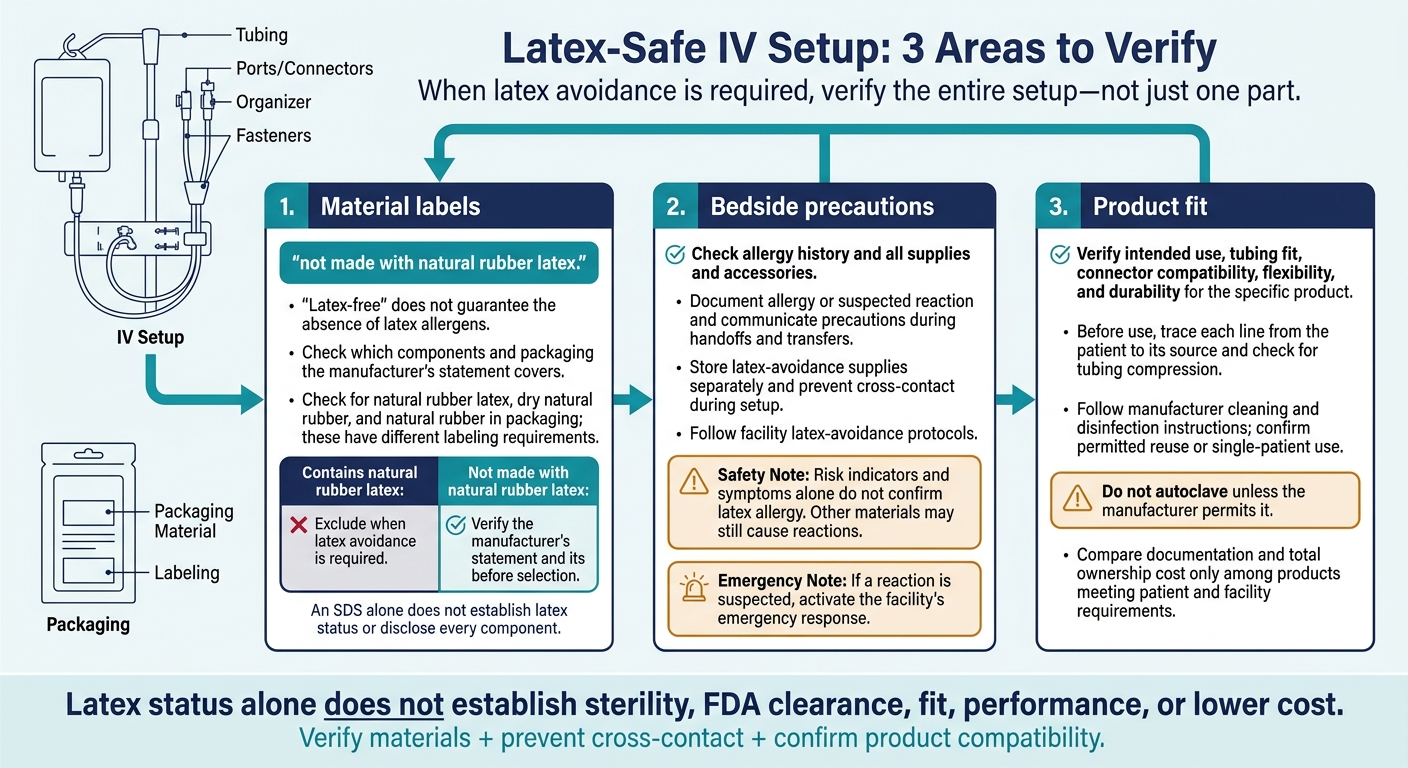
Latex-Safe IV Setup: 3 Areas to Verify
LATEX FREE ALERT! Latex Free?
sbb-itb-f779e18
Latex-Free vs. Latex IV Equipment: Materials and Labels
Labels tell you whether a product contains natural rubber latex or uses other materials. Latex equipment contains natural rubber latex in one or more parts. Equipment labeled “not made with natural rubber latex” uses synthetic materials. Neither label alone proves sterility or FDA clearance. Check exactly which parts the label covers.
| Comparison | Natural rubber latex equipment | Equipment made without natural rubber latex |
|---|---|---|
| Material status | Contains natural rubber latex in specified components | Uses other materials, including synthetic elastomers |
| Allergy considerations | Latex proteins can cause severe reactions in sensitized people | Removes intentional natural rubber latex from the device |
| Labeling language | Must carry the FDA-required natural-rubber warning | FDA recommends “not made with natural rubber latex” |
| Verification | Identify which parts carry the warning | Confirm which components and packaging the manufacturer’s statement covers |
FDA wording matters because a label’s scope isn't always clear.
What “Not Made With Natural Rubber Latex” Means
FDA recommends “not made with natural rubber latex” rather than an absolute “latex-free” claim. The reason: the complete absence of latex allergens is difficult to guarantee scientifically, so “latex-free” can give false reassurance.
Where IV Equipment May Contain Natural Rubber
Natural rubber may be present in patient-contacting parts, dry components, or packaging.
| Location or form | Exposure and labeling check | Purchasing check |
|---|---|---|
| Patient-contacting natural rubber latex | Check injection sites, ports, connectors, and other relevant parts for the latex warning | Request component-specific material documentation |
| Dry natural rubber components | Ask whether the product contains dry natural rubber, not just latex | Confirm whether a separate warning applies |
| Natural rubber in packaging | Check applicable packaging warnings and whether packaging contacts the device | Confirm packaging materials as well as device materials |
Device and packaging warnings use different regulatory language, so check both.
U.S. Labeling Rules for Natural Rubber
Under 21 CFR 801.437, medical devices that contain natural rubber latex and contact humans must carry this warning:
Caution: This Product Contains Natural Rubber Latex Which May Cause Allergic Reactions.
Dry natural rubber and natural rubber in packaging have separate labeling requirements. Check the current regulation and manufacturer label for the exact wording.
Patient Compatibility and Bedside Safety
Verifying materials is only the first step. Bedside handling determines whether latex exposure is prevented.
Screen for Latex Allergy and Check All Supplies
Match equipment to the patient’s history, then check every accessory in the room. Use both allergy history and device labels to guide your choices.
Documented or suspected latex allergy, repeated exposure - including repeated IV access - and work-related latex symptoms call for bedside precautions. But risk indicators and symptoms alone do not confirm latex allergy. Distinguish immediate latex allergy from delayed contact dermatitis and simple irritation.
Document the allergy or suspected reaction, communicate precautions, and follow the facility’s latex-avoidance protocol. Equipment made without natural rubber latex can still cause reactions to adhesives, processing chemicals, or other materials.
Keep latex out of the bedside field during storage, setup, and handoff - not just when selecting supplies.
Prevent Latex Cross-Contact and Prepare for Reactions
Store latex-avoidance supplies separately and prevent cross-contact during setup. Communicate allergy status during every handoff and transfer.
If a reaction is suspected, activate the facility’s emergency response. Latex avoidance reduces exposure, but it does not replace infection prevention or line tracing.
Check IV Line Organizer Materials and Cleaning Instructions
Check accessory materials too, especially when using reusable line organizers.
Beata Clasp from BeataClasp is a latex-free IV line organizer. Verify current material documentation, tubing fit, and mounting compatibility.
Follow the manufacturer’s cleaning instructions, and do not autoclave the organizer. Before reuse, verify whether it is intended for single-patient use.
Comparing Performance and Purchasing Requirements
Once bedside latex precautions are in place, compare products by fit, documentation, and total cost. Latex status alone does not determine fit, durability, or cost. Assess the specific device, material blend, and intended use - not just the material category.
The table below separates purchasing factors from latex-label checks.
| Purchasing factor | Equipment not made with natural rubber latex | Equipment containing natural rubber latex |
|---|---|---|
| Patient compatibility | For latex avoidance, use only when verified not made with natural rubber latex | Exclude when latex avoidance is required |
| Flexibility | Depends on the polymer blend and device design; assess for the intended use | Depends on the polymer blend and device design; assess for the intended use |
| Connector compatibility | Check tubing fit and specified connector compatibility | Check tubing fit and specified connector compatibility |
| Intended use | Confirm the device is approved for the planned use under facility policy | Confirm the planned use and whether facility policy permits latex exposure |
| Documentation | Request a manufacturer declaration confirming “not made with natural rubber latex” | Request component-specific natural rubber documentation |
| Cost | Compare total ownership costs for products that meet facility requirements | Compare total ownership costs only when latex use is permitted |
Material properties and costs differ by product. Neither category necessarily performs better.
Verify Device and Accessory Documentation
Request intended-use information, component material declarations, a Safety Data Sheet (SDS) where applicable, and manufacturer contact information. An SDS alone does not establish latex status or disclose every component. Ask the manufacturer to clarify unclear claims before purchase or use. Reviewing IV line safety tips can also help staff identify potential risks during the evaluation process.
Record facility checks of fit and function separately from manufacturer claims. Request evaluation samples before buying in bulk - a material declaration does not prove compatibility with every IV setup.
Choose Equipment Based on Exposure Risk and Facility Policy
When latex avoidance is required, choose verified equipment not made with natural rubber latex. Follow facility-wide line management protocols to prevent patient or staff latex exposure, document the approved choice, and reject substitutions that do not meet facility policy.
Conclusion: Verify Materials Throughout the IV Setup
After comparing products, check the entire IV setup at the bedside for natural rubber latex to mitigate common IV line risks. Include tubing, organizers, fasteners, and packaging.
Before use, review the manufacturer’s instructions and follow approved cleaning and disinfection directions. Don’t autoclave unless permitted. Confirm that connectors fit, keep tubing free from compression, and trace each line from the patient to its source.
FAQs
What if my IV equipment has no latex label?
If your IV equipment has no latex label, check its materials with the manufacturer or your facility’s clinical engineering department to confirm it’s safe for patients with latex sensitivities.
When patient histories are unknown or mixed, choose equipment clearly labeled or documented as latex-free, such as the Beata Clasp. This helps prevent latex-related allergic reactions in patients and staff while supporting compliance with safety standards.
Can latex allergy develop after years of IV use?
The provided search results don’t confirm whether a latex allergy can develop after years of IV use. For patients or staff who already have latex sensitivities, latex-free equipment is needed to avoid allergic reactions.
The Beata Clasp uses latex-free, antimicrobial material to help prevent complications linked to latex exposure in healthcare settings.
How can I verify latex safety for home IV care?
Check the packaging and manufacturer specifications for every IV component, including catheters, tubing, and line management tools. Each must be explicitly labeled latex-free. For accessories such as the Beata Clasp, confirm that the manufacturer states the materials are 100% latex-free.
Choose latex-free materials to help protect patients with latex sensitivities from latex-related allergic reactions.