
Most IV line slowdowns come from the same seven trouble spots: tracing lines, moving pumps, tubing tangles, room transfers, bed exits, cleaning steps, and missing supplies. If I had to sum it up in one line, it’s this: small IV delays stack up into lost bedside time and more room for errors.
IV therapy touches 70% to 90% of hospitalized patients, and mistakes tied to IV care show up often in medication harm. In this piece, I’d point readers to two big takeaways:
- Movement-heavy tasks usually cost the most time
- Cleaning shortcuts carry the biggest infection risk
- Line mix-ups, pump checks, and supply gaps can turn simple tasks into multi-step rework
- Clear routing, visible labels, and bedside prep can cut friction during care
Quick comparison
| Workflow gap | What slows care down | Main risk |
|---|---|---|
| Line tracing | Crossed or hard-to-follow tubing | Wrong-line errors |
| Pump moves | Rechecking channels during repositioning or transport | Paused or mismatched infusions |
| Tubing tangles | Loose lines bunching together | Snags, pulls, contamination |
| Room transfers | Rechecks before and after transport | Handoff mistakes |
| Bed exits | Unsecured tubing during standing | Falls or IV dislodgement |
| Cleaning steps | Scrub-and-dry time at each access | Bloodstream infection |
| Supply access | Missing swabs, caps, labels, or flushes | Delays and workarounds |
Put simply: when lines are hard to trace, move, clean, or reach, nurses lose time and patients face more risk. Improving these workflows requires structured line management awareness. That’s the core message of the article.
sbb-itb-f779e18
1. Line tracing
Line tracing is often the first bottleneck because every infusion check starts here. Following each IV line from the bag to the patient can take a few minutes. Over a full shift, that adds up fast.
And the cost isn't just time. One lab study found line-tracing errors in 7.7% of routine tasks, and high-alert drugs were involved in 92% of IV line mix-ups.
The risk goes up when tubing crosses, pump layouts change from room to room, or the patient moves and the setup shifts. A float nurse stepping into an unfamiliar room has to sort through all of that on the fly. That mental strain can make it easier to adjust the wrong pump or flush the wrong line.
A few simple habits help:
- Label tubing 6–8 inches from the hub
- Trace one infusion at a time
- Do a brief verbal line check during handoff
Beata Clasp can help support those steps by keeping lines apart and easier to follow. That can mean faster tracing, fewer double-checks, and less confusion at handoff.
Once tracing is clear, the next slowdown often shows up when the pump needs to move.
2. Pump moves
Every pump move matters, as hospital safety starts at the bedside. It doesn’t matter if you’re repositioning a patient, answering an alarm, or heading to transport. Each move calls for a new check.
The Joint Commission and ISMP guidance says clinicians should verify seven things before starting or changing an infusion: the patient, weight if needed, the drug and solution, concentration, dose and rate, the correct channel, and the line-to-patient connection.
That takes time, and the time adds up fast. One smart pump analysis across four hospitals found that responding to pump alarms alone used 10–13 hours of nursing time per day. Add multiple channels, and the workload grows in a hurry.
In med-surg rooms, it’s common for patients to have 2–4 infusion channels running at the same time. So when one pump moves, the task usually isn’t just “move the pump.” It turns into a small but careful check before and after the move.
That means making sure:
- each channel still matches its label
- no lines kinked during the move
- no critical drips paused by accident
Transport brings another layer. Staff often need to consolidate pumps, trace every line, check battery status, and document settings before departure and again on arrival. Then, once the patient gets there, the full check starts over.
When lines are clearly separated, the post-move check tends to go faster. Beata Clasp can help keep lines apart and easier to trace during moves.
Once the pump is back in place, tangled tubing often becomes the next slowdown.
3. Tubing tangles
Tubing tangles - often called "spaghetti syndrome" - happen when IV, oxygen, and feeding lines cross over each other during mobility or transport.
The first issue is simple: line tracing gets slower. When tubing overlaps, loops around equipment, or drifts into a messy bundle, staff need more time to sort out which line goes where during movement and handoff. And if that tangle spreads past the bedside, room transfers can slow down too.
There’s also a safety side to it. Tubing that sags or bunches up can end up on the floor, which increases contamination risk and the chance of hospital-acquired infection. Loose lines can snag on bedrails, furniture, or equipment wheels while a patient is being moved or transferred. One line awareness training resource warns that tangled tubing can become dislodged, impinged, or wrap around a patient's neck or limbs.
BeataClasp helps by keeping lines apart at the bedrail. That makes them easier to trace and less likely to tangle during movement - especially when the patient needs to be moved.
4. Room transfers
When IV tubing stretches beyond the bedside, room transfers often become the next slowdown. Moving a patient from one room or unit to another calls for a full IV line check before and after transport. Before the move, the sending nurse checks patency, site condition, infusion rates, connections, and labels. When the patient arrives, the receiving nurse goes through the same check again. And once the bed is in motion, that process gets harder to control.
Transport adds risk because equipment problems and tubing misconnections happen often during movement, especially when tubing is hard to reach or not secured well.
As the bed moves, tubing can snag on bed rails, carts, and elevator doors. A simple fix helps: assign one person to watch the lines and place extension sets before departure. That can cut delays during transport.
Then comes the next bottleneck: communication. The handoff creates more checking work because the receiving nurse has to re-trace lines, confirm infusion rates, and fix missing details.
Keeping lines organized before transport can shorten re-tracing after arrival. BeataClasp helps by separating lines and keeping route labels in view.
5. Bed exits
Getting out of bed sounds simple. In practice, it can be one of the highest-risk moments for a patient connected to more than one IV line.
A patient shifts to the edge of the bed, swings their legs out, and stands. Those moves happen fast, and many people do them without thinking about the tubing attached to them. That’s where trouble starts. Slack can tighten, tubing can kink, or the line can pull at the insertion site. Then the cascade begins: pump occlusion alarms, loose dressings, partial dislodgement, or a full IV restart. In other words, every bed exit can turn into a full recheck.
The fall risk matters just as much. If tubing drops to the floor, it can become a trip hazard, especially in dim light or when a patient moves in a hurry. AHRQ's hospital fall toolkit specifically identifies being tethered to an IV pole as a fall hazard.
The highest-risk moments usually happen during unassisted exits. A patient may stand up and simply forget they’re still connected. That can tip the IV pole, pull out the catheter, or throw off balance halfway through standing.
A few steady habits help cut down the risk: place the IV pole on the exit side, keep tubing off the floor and away from the bed frame, and do a quick line sweep before the patient stands. It also helps to bundle lines before standing so there’s less chance of a sudden snag.
After the patient gets back into bed, check the slack, insertion site, and securement again before moving on to cleaning and reset.
Once the patient is settled, the next slowdown often comes during cleaning steps.
6. Cleaning steps
Every port access starts the same way: hand hygiene, scrub, full dry time, then connection.
Hand hygiene comes first, before touching any port or tubing, even if gloves are on. After that, the port should be scrubbed with friction using 70% isopropyl alcohol or an alcohol-based chlorhexidine pad for about 15 seconds. That timing isn’t just a box to check. One in vitro study found about a 20-fold reduction in colony-forming units (CFU/mL) between a 3-second scrub and a 15-second alcohol scrub on contaminated catheter hubs. Those extra seconds matter.
Then comes the part people can be tempted to rush: the port must air dry fully before access. Dry time is about 5 seconds for isopropyl alcohol and around 20 seconds for alcohol-based chlorhexidine. Nurses also look for visible contamination, moisture, or damage before reconnecting. Across many patients, that scrub-and-dry time can add several minutes to a med pass.
If tubing touches the floor, a bed rail, or any other nonsterile surface, the line may need to be re-scrubbed, the connector may need to be replaced, or the full tubing may need to be replaced. Full tubing replacement can add 10 to 20 minutes of rework. And when lines are loose, tangled, or draped over bedding, that kind of contact becomes a lot more likely. A step that should take moments can suddenly eat up time.
Keeping lines grouped, elevated, and off nonsterile surfaces are key [ways to improve IV line efficiency] (https://beataclasp.com/blogs/patient-safety-blog/6-ways-to-improve-iv-line-efficiency-in-clinical-settings) and cut down on that rework. BeataClasp can help separate lines and make clean access faster.
One quality improvement initiative centered on hand hygiene and CLABSI bundle compliance achieved an 89% reduction in CLABSI rates, dropping from 31.7 to 3.5 per 1,000 line-days. After cleaning, the next bottleneck is supply access.
7. Supply access
When a nurse needs to access a port, change a cap, or reconnect a line, the job can grind to a halt if a basic item is missing. No swabs. No cap. No label. No securement device. At that point, the nurse has to step away from the bedside, and the line task stalls before access or reconnection is fully done.
One observational study found that a nurse was interrupted 43 times in 10 hours, and nearly a quarter of those interruptions came from missing supplies or equipment. Over a 12-hour shift, even short 3- to 5-minute detours for supply gaps can take away 30 to 60 minutes of direct care time.
The problem is often simple, but it adds up fast. Missing alcohol swabs, disinfecting caps, sterile gauze, flushes, extension sets, or labels can force nurses to leave the bedside, put off dressing changes, or use tape as a workaround. Guidance recommends keeping disinfecting supplies readily available at the bedside.
Documentation can slip too. If labels aren't within reach, tubing may get connected first and labeled later - or not at all. Then the next nurse is left without a clear change date. That makes supply access one of the easier bottlenecks to stack up against the others.
BeataClasp helps keep line connection points visible and within reach. The side-by-side look below shows how these gaps affect time, safety, and flow.
Side-by-side look at the 7 bottlenecks
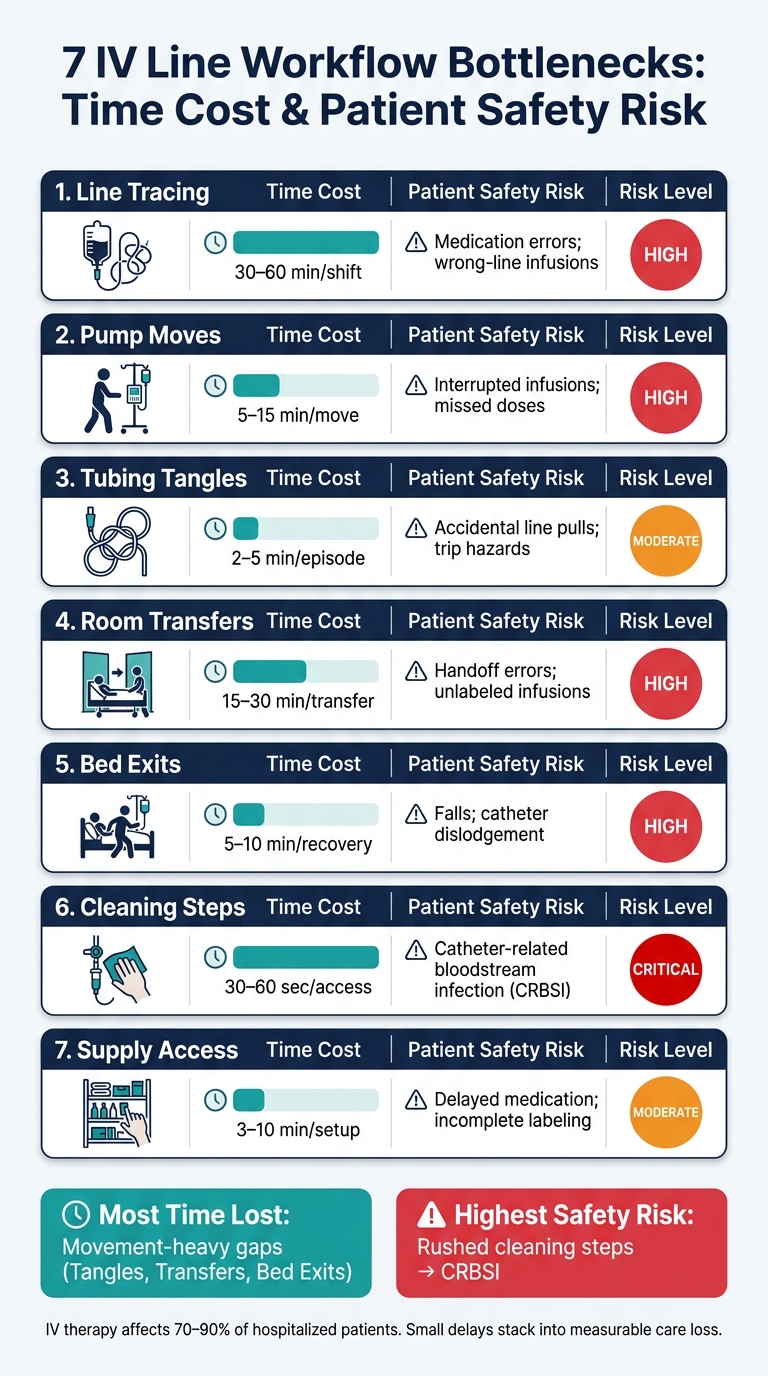
7 IV Line Workflow Bottlenecks: Time Cost & Patient Safety Risk
Each of the seven gaps in this article starts for a different reason. But they all drain the same scarce resource: nurse time. The table below puts each bottleneck next to its main cause, day-to-day workflow cost, and the patient safety risk tied to it.
| Bottleneck | Main cause | Typical workflow impact | Primary patient safety risk |
|---|---|---|---|
| 1. Line tracing | Multiple lines and inconsistent routing | 3–10 minutes per check; 30–60 minutes per shift | Medication errors; wrong-line infusions; incompatible drips |
| 2. Pump moves | Transport logistics | 5–15 minutes per move | Interrupted infusions; line dislodgement during transport; missed medication doses |
| 3. Tubing tangles | Loose, overlapping lines | 2–5 minutes per untangling episode | Accidental line pulls; occlusions; trip hazards for staff and patients |
| 4. Room transfers | No transfer checklist | 15–30 minutes per transfer | Handoff errors; unlabeled infusions; contamination during handling |
| 5. Bed exits | Unsecured lines during standing | 5–10 minutes to recover after an unplanned exit | Falls; catheter dislodgement; skin injury at insertion sites |
| 6. Cleaning steps | Rushed hub disinfection | 30–60 seconds per access | Catheter-related bloodstream infection (CRBSI); increased length of stay |
| 7. Supply access | Missing bedside supplies | 3–10 minutes per setup | Delayed medication delivery; improvised workarounds; incomplete labeling |
Look across the rows and a clear pattern shows up. Movement-related bottlenecks eat the most time, while cleaning carries the highest infection risk.
The movement-heavy issues - tubing tangles, room transfers, and bed exits - create the most day-to-day friction, requiring proactive IV line management. Line tracing and pump moves slow down rechecks and handoffs. These challenges often vary based on clinical settings, such as ICU vs. regular ward environments. Cleaning steps take only a few seconds each time, but the downside is much more serious when that step gets rushed.
Conclusion
The table points to the same pattern in all seven gaps: small delays add up fast. On their own, each bottleneck may look minor. But 30 interruptions that last two minutes each can wipe out about one hour of bedside time in a 12-hour shift. That’s one hour taken away from direct care.
The biggest time loss comes from movement-heavy gaps. The biggest safety concern comes from cleaning shortcuts, highlighting the need for essential IV line safety.
The practical move is simple: cut line complexity before care gets busy. Standard routing and clear labeling can turn minute-long slowdowns into a few seconds. Untangling and re-routing lines isn’t just annoying - it’s a measurable workflow loss.
Beata Clasp helps cluster and secure IV lines near the patient, which supports faster tracing and safer mobility.
Better line organization means less rework, fewer interruptions, and safer care.
FAQs
Which IV bottleneck wastes the most nursing time?
Reinserting a dislodged IV line is the biggest time drain here, taking 16 to 20 minutes each time it happens. That’s not a small delay in a busy care setting.
Untangling lines slows things down too, though it usually takes less time at 6 to 10 minutes per incident.
When those minutes add up, nursing efficiency can take a hit, and patient safety can be affected. Tools like the Beata Clasp help by keeping lines secure and reducing tangles.
How can nurses reduce IV line mix-ups during handoff?
Use bedside handoff so the outgoing and incoming nurses can inspect all lines, sites, and equipment together, right at the bedside. That shared view matters. It lets both clinicians trace each line from the insertion site to the pump or bag, check the infusion rate in the electronic health record, and confirm that color-coded labels match what’s being given.
Structured communication tools such as SBAR or I-PASS help keep the handoff clear and reduce the chance that key details slip through. And simple line-management tools, such as the Beata Clasp, can make a big difference by keeping lines separated and easier to follow.
What bedside supplies help prevent common IV care delays?
Dedicated organization and securement tools can help prevent common IV care delays. They keep lines separated, easy to see, and off the floor.
The Beata Clasp is built for that job. It attaches to bed rails or IV poles, and its separate grooves help organize tubing so line tracing is easier. That setup can also cut down on tangles, lower contamination risk, and help prevent accidental dislodgement.