
IV line training cuts patient harm when it focuses on the tasks staff do every day. In the studies covered here, training was linked to fewer IV dose mistakes, better first-stick success, lower bloodstream infection rates in some units, and better line setup and upkeep. I’d sum it up like this: when teams learn, practice, and re-check IV skills, patients are safer.
Here’s the short version:
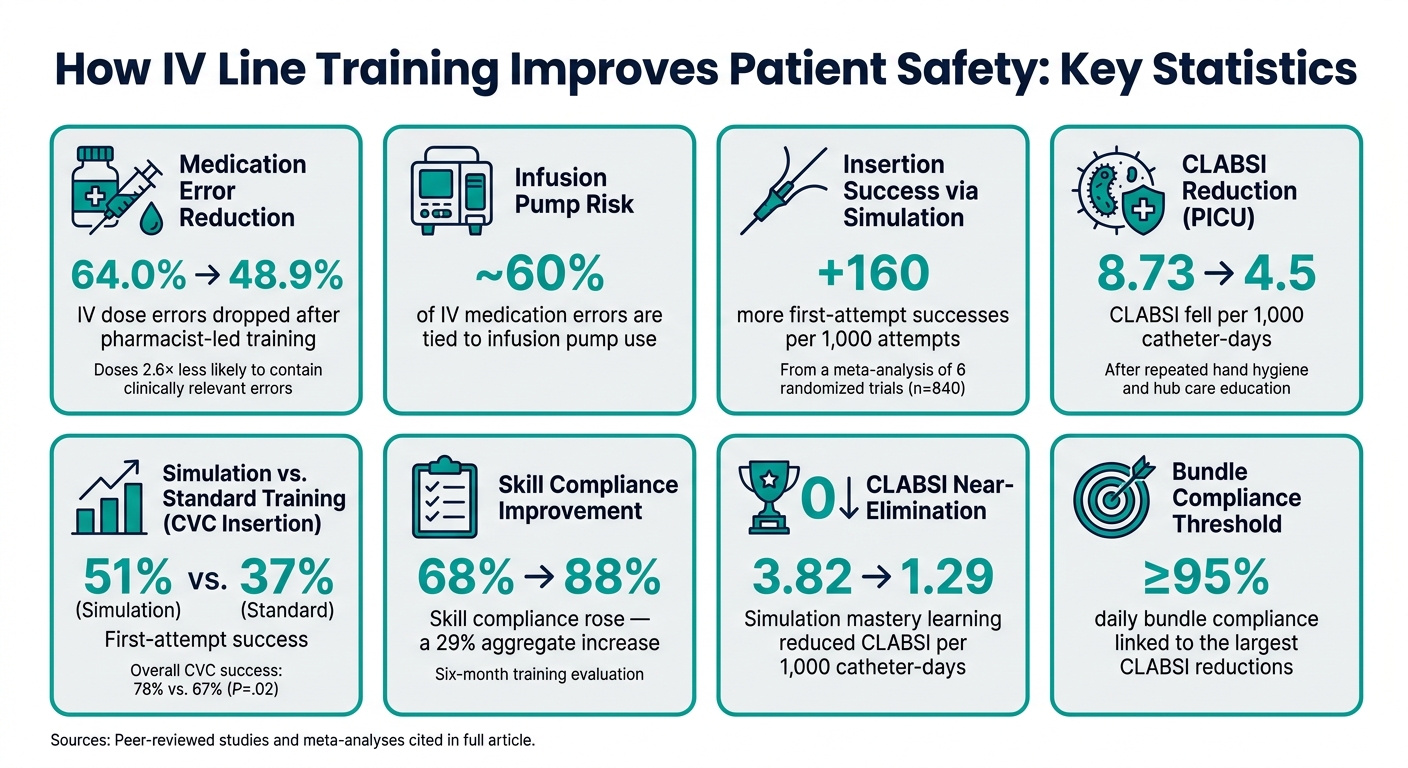
- Medication safety: one program cut clinically relevant IV dose errors from 64.0% to 48.9%
- Pump safety: about 60% of IV medication errors were tied to infusion pump use
- Insertion success: simulation training led to 160 more first-attempt successes per 1,000 attempts
- Infection control: one PICU dropped CLABSI from 8.73 to 4.5 per 1,000 catheter days
- Daily workflow: effective line management including tracing, labeling, and pump checks help stop wrong-route infusions and tubing mix-ups
- Program design: training works best when it includes teaching, hands-on practice, checklists, audits, and repeat reviews
What matters most is not just teaching IV skills once. It’s making sure staff can show the skill, use it at the bedside, and repeat the same safe steps during setup, medication changes, dressing care, handoffs, and patient movement.
If you want the takeaway in one line, it’s this: IV line training improves safety when it turns safe habits into standard daily practice.
IV Line Training: Key Patient Safety Statistics
Peripheral IV Insertion (Venipuncture) - Clinical Nursing Skills | @LevelUpRN
sbb-itb-f779e18
Evidence Linking IV Line Training to Safer Patient Outcomes
The evidence behind IV line training points in a pretty clear direction: when teams get structured instruction, preventable mistakes drop, and some patient safety outcomes improve. The strongest findings come from controlled before-and-after studies, orientation-based teaching, and simulation work.
Medication Errors, Complications, and First-Attempt Success Rates
One pharmacist-led program cut clinically relevant IV dose errors from 64.0% to 48.9% on the intervention ward after lectures, ward teaching, and protocol changes. After that training, doses on the intervention ward were 2.6 times less likely to include clinically relevant errors, while the control ward did not improve. Separate data showed that tenfold infusion-rate errors dropped from 2.3 to 0.6 per 100 admissions after targeted education and process changes.
The same trend shows up in IV insertion. Simulation-based training improves vascular access performance. A meta-analysis of six randomized trials with 840 participants found 66 more overall successes and 160 more first-attempt successes per 1,000 attempts compared with standard education. A separate randomized nursing study also found fewer IV insertion attempts per patient in the simulation group (P = 0.043).
In pediatrics, the pattern held up. When teams used insertion and maintenance standards, rates of blockage, phlebitis, infiltration, and local infection went down. The trained group also had better first-attempt success than controls.
Infection Outcomes Tied to IV Education
Training matters even more when it covers line care after insertion. In a pediatric ICU, repeated teaching on hand hygiene and hub care through a line awareness program reduced CLABSI from 8.73 to 4.5 per 1,000 catheter days. In a NICU, simulation-based central-line training paired with bundle audits led to a sustained drop in CLABSI. One-on-one retraining and re-education helped keep those gains in place.
Not every bundle project produced a statistically significant drop in infection rates, even when care practices improved. A non-ICU central-line maintenance bundle covering 25,542 catheter-days improved dressing care compliance, but the 43% decrease in CLABSI on intervention wards did not reach statistical significance. At the same time, catheter care practices improved on both intervention and control wards.
Across these studies, the pattern is hard to miss: training improved dose accuracy, insertion success, and maintenance compliance. Infection rates fell most often when education was repeated and paired with bundles and audits.
Which Training Methods Show Measurable Impact
Not all IV line training works the same way. What matters is not just whether people learn the material, but whether the training changes what they do at the bedside.
Didactic, Blended, and Simulation-Based Training
Didactic instruction - lectures, modules, or e-learning - helps with knowledge scores and self-reported confidence, especially for new hires, nursing students, and residents.
Simulation-based training shows the steadiest gains in procedural performance. In a prospective randomized study of 185 residents across 495 observed central venous catheter (CVC) insertions, simulation-trained clinicians had a first-attempt cannulation success rate of 51% compared with 37% for peers trained in the usual way (P = .03). Their overall CVC insertion success was also higher: 78% versus 67% (P = .02). A separate meta-analysis of seven randomized controlled trials (n = 866) found that simulation improved overall insertion success, with a risk ratio of 1.08 (95% CI 1.03–1.13).
Blended programs combine online learning with supervised simulation practice, which gives learners both the background and the hands-on reps. In the studies cited here, blended programs improved knowledge scores by 31% and skills by 24%. In another study, 89% of nurses reached satisfactory practice right after training, and 75% were still at that level at follow-up.
| Modality | Main Content | Typical Learners | Measured Benefit |
|---|---|---|---|
| Didactic (classroom/e-learning) | Anatomy, infection protocols, device selection | New hires, nursing students, residents | Improved knowledge scores and self-reported confidence |
| Blended (online + simulation) | Insertion technique, line care, infection prevention | ICU/ED/oncology nurses, nurse residents | 31% knowledge gain and 24% skill improvement; 89% satisfactory practice post-program |
| Simulation-based | Needle placement, ultrasound guidance, CVC insertion | IV teams, ED/ICU nurses, residents | 51% vs. 37% first-attempt cannulation success; 78% vs. 67% overall CVC insertion success |
Competency Validation, Checklists, and Return Demonstration
Competency has to be checked in a formal, standardized way. It can't rest on verbal self-attestation alone. The Infusion Nurses Society (INS) says this plainly: competency cannot rely on verbal self-attestation; it must be formally assessed using standardized methods.
A practical approach uses four steps:
- knowledge
- observation
- simulation
- supervised clinical performance
This validation should happen at onboarding and then again at regular intervals, with more frequent checks in high-risk units. Checklists help by breaking each procedure into observable steps and recording revalidation. That lets validators score what actually happened and give pointed feedback, instead of going off general impressions.
Line-tracing protocols add another layer. They make tracing from patient to pump a required step, which helps build misconnection prevention into daily practice. These validated skills matter most when staff use them during line maintenance, tubing setup, and pump organization. The next section looks at how that kind of verified practice cuts infection risk, workflow mistakes, and falls.
How Training Reduces Infections, Workflow Errors, and Fall-Related Risks
Once staff can show the skill, the next step is simple: does that training change what happens at the bedside?
Infection Prevention Through Line Maintenance and Bundle Adherence
Training on insertion and maintenance bundles can lower CLABSI rates when staff follow the steps every time. Multiple studies show drops of 30% to 70% after targeted education, and some ICUs have kept CLABSI rates near zero through bundle programs that ran for years.
Two actions stand out: hand hygiene before any line contact and catheter hub disinfection. One continuous education program found these were the top preventive steps tied to lower CLABSI rates. The biggest drops happen when teams hit ≥95% daily compliance across all bundle elements.
There’s more. Better connector disinfection is linked to an incidence rate ratio of about 0.77. And facilities with ≥80% audit coverage plus >90% bundle compliance have reported elimination of CLABSI in ICUs.
That said, training isn’t a one-and-done fix. CLABSI rates can creep back up when education stops. Some studies found early gains, then later increases once ongoing staff training was no longer kept in place.
Tubing Organization, Pump Workflow, and Misconnection Prevention
Training does more than cut infection risk. It also helps reduce setup mistakes and handoff errors. Tubing misconnections and wrong-route infusions are serious events, and they often come back to how lines are arranged, labeled, and passed from one clinician to the next.
One habit matters a lot here: line tracing. Staff are taught to physically trace each line from the fluid source, through the pump, all the way to the patient before starting or changing an infusion. It sounds basic, but this step can catch the kind of mistake that slips through when a room gets busy.
Handoffs should also include:
- Joint line tracing
- Verification of each infusion against orders
- Confirmation that pump settings match the intended therapy
Labeling both ends of every line also helps. So does keeping lines from different routes on opposite sides of the bed, such as IV lines on one side and epidural lines on the other. That simple separation cuts down on mix-ups.
Direct research tying IV training to fewer falls is limited. Still, training that keeps tubing routed, labeled, and off the floor can reduce trip hazards, especially when patients are getting up and moving. BeataClasp offers an antimicrobial, latex-free, easy-to-clean IV line organizer that supports the line-routing habits taught in training.
Those outcomes depend a lot on how the training program is built, which the next section covers.
Building an Effective IV Line Training Program in U.S. Care Settings
Once you know training improves outcomes, the next job is simple in theory and hard in practice: turn that progress into a program people can repeat, follow, and measure. In U.S. care settings, strong IV training links competency checks with outcome tracking.
Core Program Elements and Outcome Measures
Current infusion standards call for standardized education, competency assessment, and documentation. CDC guidance adds a clear timing rule: staff should be trained before they perform duties and at least annually, with added retraining whenever practices, equipment, or adherence problems change.
Core training should include device choice, insertion, securement, pump use, tubing setup, complication recognition, infection surveillance, and documentation. The table below translates that evidence into a practical program structure.
| Training Topic | Recommended Format | Frequency | Outcome Metric |
|---|---|---|---|
| Device selection & insertion | Onboarding + validation | At hire; annual | First-attempt success rate; CLABSI rate per 1,000 catheter-days |
| Securement & dressing changes | Hands-on practice with checklist | At hire; annual; post-product change | Dressing integrity audit score; unplanned line removal rate |
| Pump use & tubing setup | Online module + simulation | Annual | IV medication error rate; pump-related incident reports |
| Line tracing & labeling | Simulation + audit | At hire; quarterly | Misconnection incident rate; line reconciliation compliance |
| Infection prevention bundles | Onboarding + validation | Annual; after CLABSI event or audit finding | CLABSI rate; bundle adherence score |
| Complication recognition | Case-based discussion + simulation | Annual | Time-to-recognition; escalation documentation rate |
| Fall risk & tubing organization | Safety huddles + visual audits | Monthly | IV-related fall incidents; "lines off floor" audit score |
| Patient & caregiver education | Role-play + teach-back | At discharge; annual review | Caregiver understanding of line care; entanglement incident reports |
Two measures matter a lot for infection tracking: CLABSIs per 1,000 catheter-days and the NHSN device standardized infection ratio. They show whether training is changing what happens on the floor, not just what staff can recite in a classroom.
The same logic applies to medication safety. In one pharmacist-led ICU training program, clinically relevant erroneous doses fell from 64.0% to 48.9% (p < 0.001), while the control ward showed no improvement. That's the kind of result that gives a training plan teeth.
Home care needs a different delivery model, but not a lower bar. For home infusion teams, annual competency checks, telehealth reinforcement, and micro-learning modules can help keep staff aligned with the same standards.
Bedside tools can also back up the habits taught in training. Beata Clasp helps organize tubing by keeping lines off the floor, cutting down entanglement, and making line tracing faster at the bedside.
Conclusion: What the Evidence Shows
The evidence points in the same direction: IV training improves adherence and cuts preventable harm. One simulation-based mastery learning program reduced CLABSI rates from 3.82 to 1.29 per 1,000 catheter-days. A six-month training evaluation found skill compliance rising from 68% to 88% - a 29% aggregate increase.
The link between tubing organization and fall prevention is less direct, but the day-to-day logic is hard to ignore. When staff are trained to trace, label, and route lines the same way every time, patients who are getting up and moving face fewer physical obstacles. Training, then, does more than teach a skill. It shapes daily line management at the bedside, and competency-based programs plus regular audits help those safer habits last.
FAQs
What should IV line training include?
Effective IV line training needs two things: clear instruction and hands-on practice. One without the other usually falls short.
Why does that matter? Because better training helps protect patients and cut risks like falls, infections, and misconnections.
Training should cover the basics of safe IV line care, including:
- Proper line management
- Patient assessment
- Systematic line tracing from pump to patient
- Dual-location labeling
- Aseptic technique
- Hand hygiene
- Sterile barriers for catheter procedures
- Use of tools like the Beata Clasp to keep lines organized and separated
That last point is easy to overlook, but it matters. When lines stay organized and apart, staff can trace them with less confusion and a lower chance of error.
How often should staff repeat IV training?
Staff should follow a set refresher schedule to support patient safety and steady IV management. IV line management competency assessments should be completed once a year.
Use this training cadence:
- Fundamental skills and documentation: monthly
- Line management and BeataClasp use: quarterly
- Risk prevention training: twice a year
Which outcomes best show training is working?
Training is doing its job when facilities see fewer line-related incidents, such as dislodgements, entanglements, and contamination.
Other signs are easy to spot too: lower rates of complications like CLABSIs and infiltrates, fewer tubing-related patient falls, faster line identification, and less time lost untangling lines. When those numbers move in the right direction, it shows the training is showing up in day-to-day care.